Seasons · Gilgit-Baltistan
Blossom in Gilgit-Baltistan: A Complete Guide to Pakistan's Spectacular Spring Season
For a few short weeks each spring, apricot, cherry, apple and almond orchards break into flower beneath the Karakoram, Himalaya and Hindu Kush — and the villages of Hunza, Nagar, Skardu, Shigar and Khaplu turn into some of the most photographed landscapes in Pakistan.
📅 Best window: Mid-March – Late April ⏱️ 14 min read 📍 Hunza · Nagar · Gilgit · Ghizer · Skardu · Shigar · Khaplu
There is a brief moment every year when the mountains of northern Pakistan seem to change character. Winter loosens its grip, snow still clings to the high peaks, irrigation channels begin carrying meltwater, and orchards that have stood bare for months suddenly fill with delicate shades of white, pink and pale green. This is blossom season in Gilgit-Baltistan.
Across the valleys, apricot, cherry, apple, peach, almond and other fruit trees burst into flower. Against a backdrop of the Karakoram, Himalaya and Hindu Kush, ordinary village orchards become extraordinary landscapes. Ancient forts rise above flowering terraces, rivers cut through narrow mountain valleys, and snow-covered summits provide a dramatic backdrop to one of Pakistan’s most beautiful seasonal spectacles.
But blossom season is about more than flowers. It’s a chance to experience Gilgit-Baltistan’s villages, orchards, food, architecture and hospitality at a particularly attractive time of year — for photographers, for culture enthusiasts watching agricultural life awaken after winter, and for travellers simply looking for a quieter mountain escape. This guide covers when to go, where to go, what to expect, what to eat, how to travel, and how to do it respectfully.
The Setting
Where Mountains and Orchards Meet
Gilgit-Baltistan is a mountainous administrative region in northern Pakistan, bordering Afghanistan, China and the Indian-administered territories to the east — one of the world’s great high-mountain regions, where the Karakoram, Himalaya and Hindu Kush converge. The region is home to five of the world’s fourteen 8,000-metre peaks, including K2, and more than fifty peaks exceeding 7,000 metres, with Gilgit and Skardu serving as the main gateways for mountaineering and tourism.
Yet the landscape isn’t simply a wilderness of rock and ice. For thousands of years, communities have cultivated pockets of fertile land along rivers and mountain slopes, using ingenious irrigation systems to bring glacial meltwater to terraced fields and orchards. In valleys such as Hunza, Nagar, Gilgit, Shigar and Ghanche, fruit trees form an important part of the agricultural landscape — and that combination of snow-covered peaks and flowering orchards is exactly what makes spring here so remarkable.
The Basics
What Is Blossom Season, Exactly?
Blossom season is often marketed internationally as “cherry blossom season,” but that only tells part of the story. Spring in Gilgit-Baltistan brings a succession of flowering fruit trees — apricot, cherry, apple, peach, almond, plum, pear and other locally cultivated species — and the exact combination varies from valley to valley and orchard to orchard. Colours range from almost pure white to soft and deeper shades of pink; some trees flower individually, while others create dense patches of colour across entire orchards. The effect is especially dramatic because flowering happens while many of the surrounding mountains are still snow-covered. Hunza in particular is closely associated with apples, apricots, mulberries, cherries and grapes — a reflection of how central fruit cultivation is to the region’s landscape and culture.
Why Does the Timing Vary?
There’s no single “blossom date” for all of Gilgit-Baltistan. Flowering depends on elevation, valley orientation, temperature, snowfall, winter duration, spring temperatures, local microclimate and the specific fruit species. Lower, warmer areas generally flower earlier, while higher valleys can stay in winter conditions much longer. In practice, this means following the blossom — rather than a fixed calendar date — is usually the smarter approach.
Timing
When Is the Best Time to See Blossom?
For most travellers, March and April are the key months, with flowering continuing into later spring at higher altitudes. Tourism information for Hunza and Nagar generally places the main flowering period from roughly the second week of March through the end of April, shifting with elevation.
| Period | What to expect |
|---|---|
| Early March | Early flowering may begin in warmer, lower areas. |
| Mid–Late March | Blossom becomes increasingly visible in parts of Baltistan and lower valleys. |
| Early April | Strong spring conditions across many popular destinations. |
| Mid–Late April | Excellent period for Hunza, Nagar and many orchard areas — peak season. |
| May | Later flowering can continue in higher valleys, while many lower orchards have finished. |
| June | Generally beyond the main blossom season, though some higher areas may retain late flowering. |
What You’ll See
Which Blossoms Can You See?
Most iconic
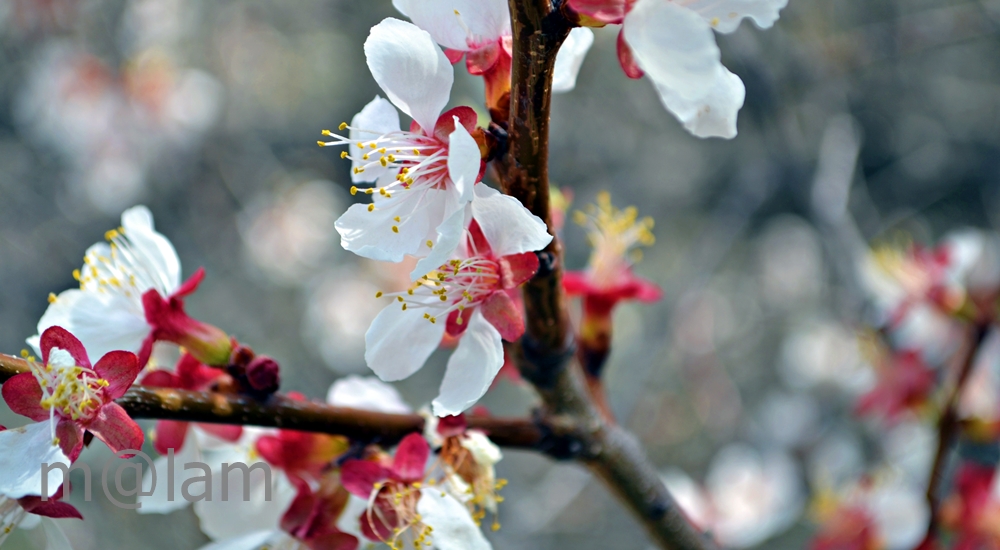
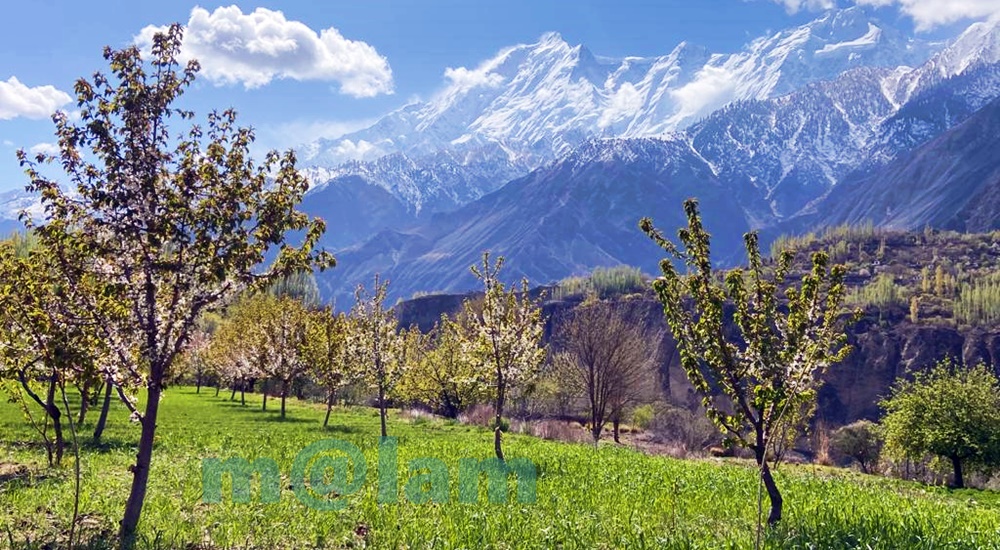
🌸 Apricot Blossom
Perhaps the most culturally and visually significant blossom in the region. White-to-pale-pink flowers cover the branches before summer fruit develops — especially prominent across Hunza and Baltistan. An apricot tree with a snow-covered peak behind it is one of the defining images of spring here.
Most photographed
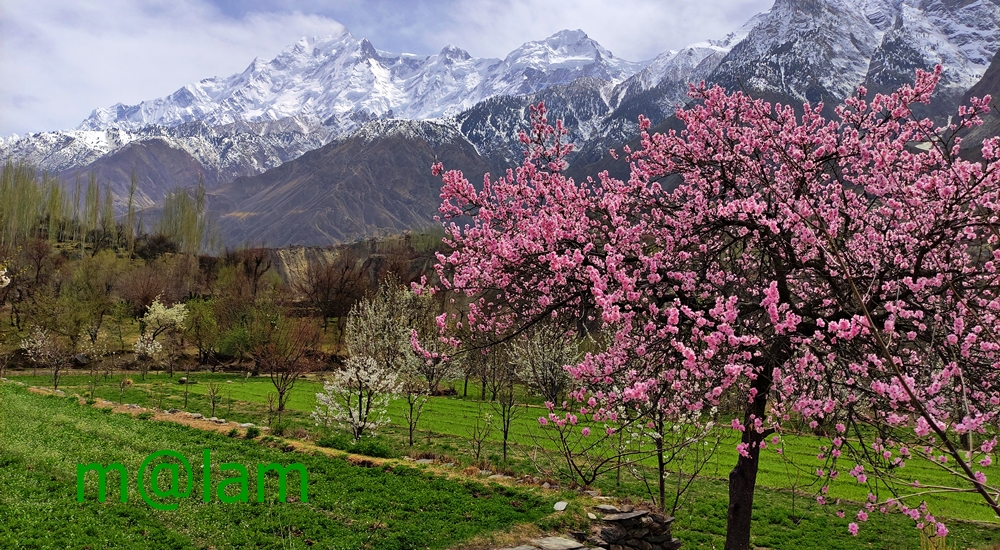
🌸 Cherry Blossom
The most recognisable pink-and-white scenes of the season, especially associated with Hunza and Nagar. Don’t expect a Japanese urban cherry-blossom festival — here blossoms sit inside working orchards, village lanes and family land, which is exactly what makes it special.
Softest colour
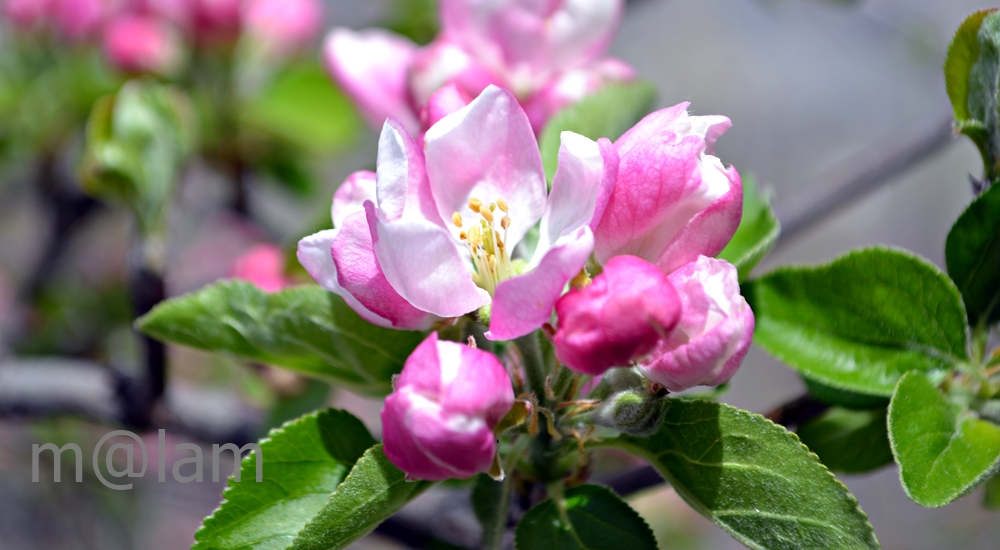
🌼 Apple Blossom
Delicate and light-coloured, apple orchards create a softer visual counterpoint to the more intensely pink cherry and apricot trees — particularly abundant in Hunza and Nagar.
Supporting cast
🌺 Peach, Almond & Plum
Peach, almond, plum and other fruit trees add further colour and variety through the season, filling out orchard landscapes alongside the headline cherry and apricot blooms.
Where To Go
The Best Places to See Blossom in Gilgit-Baltistan
If you’ve never experienced spring in Gilgit-Baltistan, Hunza is the strongest place to start. Around Karimabad, Altit, Aliabad and surrounding villages, flowering trees appear alongside terraced fields, traditional homes and historic forts — with Baltit Fort and Altit Fort offering particularly memorable settings where architecture, orchards and mountains meet.
- Extensive orchards: apricot, cherry, apple
- Framed by Ultar and Ladyfinger peaks
- Most developed tourism infrastructure
- Best for first-time visitors — focus on Lower & Central Hunza
02
Nagar Valley & Hoper
Blossom with a different perspective
Across the Hunza River, Nagar lets you look back across the water toward Hunza’s peaks and settlements, while offering its own orchards and high mountain scenery. Hoper Valley is one of Nagar’s most impressive blossom landscapes, with flowering orchards set against dramatic glacial scenery, plus Rakaposhi viewpoints nearby.
- Quieter than Hunza’s main tourist trail
- Hoper Valley: glaciers + blossom
- Rakaposhi viewpoints
- Worth visiting as a destination, not just a Hunza add-on
03
Gilgit & Bagrot Valley
The gateway with easy day trips
Gilgit is the administrative capital and a useful base for exploring nearby valleys. Bagrot Valley, southeast of Gilgit, is especially attractive in spring — almond, apricot, peach and apple trees fill out a more agricultural, village-oriented landscape without the long journey some remote valleys require.
- Good base for day excursions
- Bagrot: almond, apricot, peach, apple
- Combine with onward travel to Hunza, Nagar or Ghizer
04
Ghizer & Phander Valley
Spring in a quieter landscape
For travellers who want fewer crowds, Ghizer — in the western part of Gilgit-Baltistan — is worth serious consideration. Phander Valley is known for turquoise water and green meadows; in spring, flowering trees add another layer to an already striking landscape. Yasin and Ishkoman offer a less commercialised side of mountain life, though access and flowering timing vary.
- Phander: water + meadows + blossom
- Yasin & Ishkoman for the exploratory traveller
- Best for landscape photography over crowd-free time
On the eastern side of Gilgit-Baltistan, Skardu sits in a high-altitude basin surrounded by dramatic peaks and is the main gateway to the Karakoram’s eastern side. During blossom season, look to Chunda, Kachura, Satpara, Basho and the Soq Valley as surrounding villages emerge from winter — spring here feels more rugged than Hunza, with orchards set inside a broader cold-desert landscape.
- Kharpocho Fort, Kachura & Sadpara lakes nearby
- Chunda Valley: terraced orchards, elevated views
- A more rugged, rock-and-river character than Hunza
A short drive from Skardu, Shigar combines natural and cultural attractions unusually well. Extensive agricultural land irrigated by the Shigar River grows apricots, peaches, pears, grapes and walnuts, alongside heritage sites including the historic Shigar Fort and Amburiq Mosque. Don’t reduce a visit here to a quick blossom photo — walk the settlements and take in the traditional architecture.
- Heritage + orchards + river + architecture
- Shigar Fort & Amburiq Mosque
- Best paired with Skardu on an 8–10 day trip
07
Khaplu & Ghanche
Spring arrives at a different pace
Further east, Ghanche is home to Khaplu and a series of spectacular valleys along the Shyok River system. Because of elevation and local climate differences, flowering can occur later here than around lower Skardu. Khaplu is particularly rewarding for combining spring scenery with heritage — the historic Khaplu Palace, traditional villages and agricultural terraces create a very different visual character from Karimabad. Give it at least a night or two rather than a rushed day trip.
- Khaplu Palace + terraces + mountains
- Later blossom window than Skardu proper
- Nearby Keris also known for spring appeal
08
Kharmang Valley
Spring unfolds beside the Shyok
West of Skardu, Kharmang Valley follows the Indus River through a landscape of rugged mountains, terraced fields, traditional villages and old settlements. As spring arrives, fruit trees begin to bloom across the valley, adding delicate shades of white and pink to the otherwise dramatic mountain scenery. The lower parts of Kharmang can experience blossom relatively early, while higher villages may flower later depending on elevation and local conditions. The historic villages, orchards and riverside landscapes make Kharmang especially rewarding for travellers looking for a quieter, more authentic spring experience away from the better-known tourist centres.
- Fruit orchards + traditional villages + Indus scenery
- Blossom timing varies with elevation
- Combine with Manthokha Waterfall and nearby heritage sites
09
Karakoram Highway
Showcase of Blooming Valleys
The Karakoram Highway from Gilgit to Hunza becomes a spectacular spring corridor as orchards and roadside trees begin to flower beneath the towering Karakoram peaks. As the route climbs gradually northward, blossom unfolds at different times across villages, terraces and valleys, creating a constantly changing landscape. Nomal, Nagar and the lower Hunza Valley are particularly rewarding, with apricot, cherry, almond and apple trees adding colour to traditional settlements and dramatic mountain scenery. The journey is as much part of the experience as the destination, with rivers, suspension bridges, glaciers and high peaks appearing along the way.
- Blossom villages + orchards + dramatic Karakoram scenery
- Flowering progresses with elevation along the highway
- Nomal, Nagar and lower Hunza offer excellent spring landscapes
Beyond the Flowers
Blossom Is Also a Cultural Experience
The most meaningful way to experience spring in Gilgit-Baltistan is to understand that these orchards aren’t decorative landscapes — they’re part of people’s lives. Fruit trees contribute to household agriculture, local diets and traditional livelihoods, and in many villages orchards sit immediately beside homes, irrigation channels and cultivated fields.
Spring is a season of transition: snow retreats from lower elevations, fields are prepared, water flows more strongly through irrigation channels, trees flower and later bear fruit, and villages gradually turn green. That agricultural rhythm is exactly why a walk through a village can be more rewarding than stopping only at a famous viewpoint.
Gilgit-Baltistan is also culturally diverse rather than culturally uniform. Different communities speak Burushaski, Shina, Wakhi and Balti, with Urdu widely used as a lingua franca and English common in tourism. Burushaski (two dialects in Hunza and Nagar), Shina, Wakhi and Dhumaki (language of artisians) are among the local languages of Hunza and Nagar; Khuwar in Ghizer, Gojri is spoken only in Naltar (by a shephard community); another dialect of Shina spoken in Diamer, Darel, and Astore, while Balti is native to Skardu — and traditions, dress, music, architecture and food vary meaningfully from one valley to the next. Hunza is not Baltistan; Nagar is not Ghizer; a village in Ghanche can differ in custom and language from one in central Hunza. That diversity is one of the region’s greatest strengths.
What to Eat During Blossom Season
- Chapshuro
A popular filled pastry associated with Hunza and neighbouring areas — practical mountain food and a dish most visitors remember.
- Local breads
Vary by community and household, typically served with tea, butter or cheese.
- Balti cuisine
In Baltistan, look for dishes built on grains, meat, vegetables, noodles and soups.
- Apricots & dried fruits
Deeply tied to the region’s agricultural identity — try dried apricots, nuts and apricot-based preparations.
- Local tea
Central to hospitality throughout the north, with preparations that vary by area.
Rather than defaulting to tourist-oriented restaurants, look for reputable local establishments and guesthouses.
Practical
Weather During Blossom Season — and
What to Pack
Spring is one of the most attractive times to visit, but don’t confuse blossom season with warm-weather tourism. March and April can still be cold: expect cold mornings, pleasant afternoons, chilly evenings, snow at higher elevations, occasional rain, rapid weather changes, strong sunlight and cold winds. At higher elevations winter can persist well into spring — which is why the same month can feel dramatically different in Gilgit, Hunza, Skardu, Khaplu and an upper mountain valley.
Conditions to expect
Cold mornings
Pleasant afternoons
Chilly eveningsSnow at altitude
Occasional rainStrong sunlight
Cold winds
Variable mountain visibility
Pack in layers
- Warm base layers
- Fleece / insulated jacket
- Waterproof outer layer
- Comfortable walking shoes
- Warm socks
- Sunglasses & sunscreen
- Hat & gloves
- Power bank
- Camera batteries / cards
- Personal medication
For Photographers
A Photographer's Guide to
Blossom Season
The obvious subject is the flower — but the strongest photographs combine it with something else.
Shoot in layers
Foreground: blossom. Middle ground: village or orchard. Background: snow-covered mountain. That layering creates depth and tells a story about the landscape.
Use the golden hours
Early morning and late afternoon give softer light and more pronounced mountain textures — morning also tends to offer clearer visibility before daytime haze builds.
Look past the landmarks
Irrigation channels, orchard walls, traditional houses, farmers at work, village lanes and fruit trees beside homes often say more about Gilgit-Baltistan than a postcard viewpoint.
Put a mountain behind it
A close-up flower could be from anywhere. A blossom shot with Rakaposhi, Ultar or another recognisable peak behind it tells the viewer exactly where they are.
Responsible Photography Matters
Remember an orchard is often someone’s workplace or private property. Please don’t:
- Enter private orchards without permission
- Break branches or pull flowers from trees
- Trample crops or climb trees for photos
- Leave litter behind
- Photograph people without consent
If a local resident welcomes you into their orchard, consider buying fruit or local products in return. The best blossom photograph isn’t worth damaging the landscape that made it possible.
Logistics
How to Reach Gilgit-Baltistan During
Blossom Season
The obvious subject is the flower — but the strongest photographs combine it with something else.
✈️ By Air
Flights from Islamabad serve Gilgit and Skardu, subject to airline schedules, weather and operational conditions.
- PIA operates an ATR proppeler aircraft to Gilgit with high demand for seats. Better reserve seasts in advance
- PIA, Air Blu, and Air Sial operatef flights to Skardu on a daily basis from Islamabad and weekly from Lahore and Karachi
Flying saves considerable travel time and gives a spectacular aerial view of the northern mountains — but mountain aviation is inherently weather-sensitive.
- Don’t build an international itinerary around a same-day connecting flight without a buffer
- Gilgit is convenient if Hunza is your priority
- Skardu is the natural gateway for Baltistan
🚙 By Road
The Karakoram Highway (KKH) is the main road corridor connecting the north with the rest of Pakistan year round.
- One can travel via Babusar Pass during summers.
- It is also possible to enter Gilgit-Baltistan via Chitral
- International travellers can enter Gilgit-Baltistan via Khunjerab Pak-China border.
All above experiences offering a gradual transition from the plains into dramatic mountain terrain that flying can’t match — but it’s a demanding journey.
- Long driving days and narrow mountain sections
- Possible construction zones, landslide-prone areas and rockfall
- An experienced local driver is strongly recommended
Responsible Photography Matters
Remember an orchard is often someone’s workplace or private property. Please don’t:
- Enter private orchards without permission
- Break branches or pull flowers from trees
- Trample crops or climb trees for photos
- Leave litter behind
- Photograph people without consent
If a local resident welcomes you into their orchard, consider buying fruit or local products in return. The best blossom photograph isn’t worth damaging the landscape that made it possible.
Trip Planning
How Many Days Do You Need for a
Blossom Trip?
There can be as many options as one can think depending on the number of days available to experience blossom in Gilgit-Baltistan. Below are some of the sample itineraries.
4–5 DAYS
Hunza & Nagar Blossom Escape
- Gilgit
- Karimabad, Altit & Baltit
- Nagar (day trip)
- Attabad Lake
- Selected orchard areas
4–5 DAYS
Skardu Blossom Experience
- Skardu
- Upper & Lower Kachura
- Chunda Valley
- Shigar Valley
6–7 DAYS
Hunza + Ghizer, in depth
- Central & Upper Hunza
- Nagar & Hoper
- Cultural sites
- Ghizer & Phander
- Stronger option for photographers
8–10 DAYS
Hunza + Skardu / Baltistan
- Gilgit → Hunza → Nagar → Skardu → Shigar → Khaplu
- Both sides of Gilgit-Baltistan’s contrasting landscapes
- Order should flex around blossom timing & road/flight conditions
Is This Trip For You?
Blossom Season Suits Almost Everyone —
For Different Reasons
Photographers
The flower-and-mountain combination is exceptional.
Couples
A quieter, atmospheric setting for a mountain holiday.
Culture lovers
Agricultural landscapes become part of the travel experience.
Families
Lower-elevation sightseeing paced sensibly with comfortable stays.
Nature lovers
Blossom is one layer — rivers, glaciers and valleys stay central.
International visitors
An accessible entry point via established Hunza & Skardu tourism.
Accommodation
Where Should You Stay?
Accommodation ranges from practical hotels and guesthouses to boutique and heritage properties — the right choice depends on what you want from the trip.
- For convenience: stay around Karimabad or Aliabad when exploring central Hunza.
- For views and photography: look for properties overlooking orchards, valleys, or major mountain landscapes.
- For heritage: choose accommodation around historic areas of Hunza, Shigar or Khaplu.
- For a quieter experience: pick a village-based guesthouse away from the busiest tourist centres.
Always confirm spring operating dates, heating, hot water, road access, and backup power before booking — see our accommodation in Pakistan guide for more.
Before You Go
10 Practical Tips for Planning Your
Blossom Trip
- Don’t chase a fixed date — flowering changes every year.
- Keep your itinerary flexible — one or two spare days makes a real difference.
- Start early — mountain light is best in the morning.
- Spend time in villages — don’t limit the trip to famous viewpoints.
- Hire local expertise — a local guide or driver can find flowering areas off the standard map.
- Keep cash available — not every business has reliable card payment.
- Carry essential supplies — familiar products aren’t always available remotely.
- Check connectivity — mobile coverage varies a lot by valley.
- Allow for delays — especially for flights and long road journeys.
- Respect local communities — this landscape is someone’s home and farmland, not just a backdrop.
The Bigger Picture
Why Blossom Season Is Worth
Experiencing
The appeal of spring in Gilgit-Baltistan lies in a remarkable contrast. The mountains are immense, ancient and severe. The blossoms are delicate and temporary. One represents permanence; the other lasts only a short time. A flowering orchard beside a traditional village may be framed by a 7,000- or 8,000-metre peak. A centuries-old fort may overlook trees that will produce fruit later in the year. A narrow village lane may suddenly open onto a panorama of snow-covered mountains.
This is what makes blossom season so distinctive. It isn’t simply “cherry blossom in Pakistan” — it’s a window into the seasonal life of an extraordinary mountain region, and because the flowering period is relatively brief, the experience feels particularly fleeting.
Frewuently Asked Questions
When is blossom season in Gilgit-Baltistan?
What is the best month to see blossom in Hunza?
Is it only cherry blossom?
Where is the best place to see blossom in Gilgit-Baltistan?
Is Hunza or Skardu better for blossom?
Can I visit Gilgit-Baltistan by road during blossom season?
Can I fly to Gilgit-Baltistan?
Is March too cold for a blossom trip?
What should I photograph during blossom season?
Can I enter a private orchard to take photographs?
How long should I spend in Gilgit-Baltistan during blossom season?
Is blossom season suitable for international tourists?
Follow the Flowers
There's no single viewpoint that defines blossom season in Gilgit-Baltistan. The real experience is moving through the valleys and watching spring unfold — from flowering apricot trees in Hunza, to a wall of mountains across Nagar, to centuries-old settlements beside the Shigar River, to snow-dusted terraces in Khaplu. That's the real attraction of travelling here in spring: not simply seeing flowers, but seeing an entire region awaken.It is a paradisematic country, in which