July 2018

Basic components of tourism product

Basic Components of Tourism Product

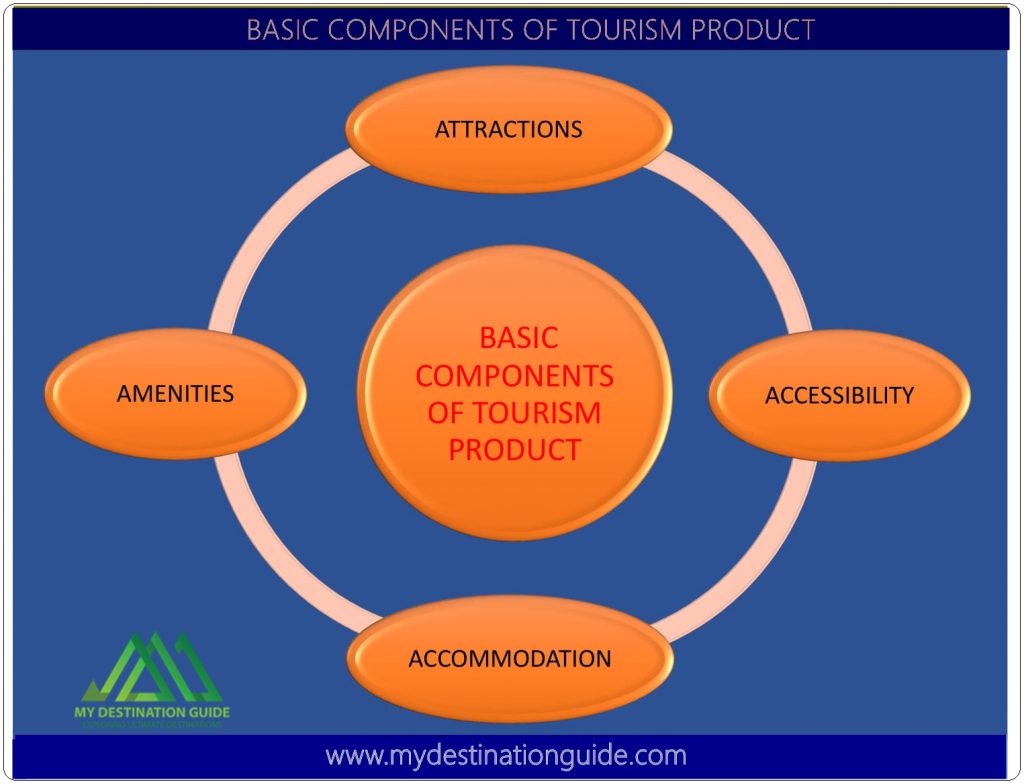
Tourism is a complex and multidisciplinary field constitutes a diverse amalgam of sectors and each sector is made up of a variety of products and services visitors/tourists choose according to their own taste and budget. Following are the basic components of tourism that can have an impact on overall tourism of a particular destination.ATTRACTIONS The primary motivation and preconditions of travel are the attractions of all kinds in a destination which are the major reason for providing pleasure to tourists. These attractions are classified as natural, manmade, and cultural which make up the major tourism product. Following are the details. Natural Attractions Natural attractions in a destination are the combination of public utilities including natural beauty, physical features, and the climatic features of the area. These attractions may include scenic places ranging from deep oceans, beaches, lakes, rivers, creeks to the mountains, landscapes, national parks, wildlife, flora & fauna, and diverse seasons. Any destination abundant in natural beauty can also fall prey to threats and challenges of managing and preserving the resources. There are many instances of destinations lost their prominence because of the impact of tourists. Manmade Attractions: Manmade attractions include the built environment by the human. E.g. historical buildings, religious monuments, leisure parks, Disney lands, museums, aquariums, zoos, and orphanages etc. Tourism can be sustained to manmade attractions if the attractions are well preserved with respect to time. Cultural Attractions: These attractions usually hold aesthetic beauty in a society including the way of life of the indigenous community in a typical natural setting which obviously has spared itself from modernization, national events and festivals, customs, dress, art, handicraft, rituals, folklore, languages and local cuisines. In a developed city cultural attraction include discotheques, live or recorded music, clubs, social events, trade fairs, exhibitions, sports competitions etc. Due to urban sprawl and modernization, indigenous communities gradually switching and adapting to modern life which results in a gradual fading of cultural beauty.ACCESSIBILITY Accessibility is a major tourism product/service and a key factor in the development of tourism. It comprises means (ports, airports, roads, highways, trails etc.) and mode (aerial, surface, and water) of transportation infrastructure which helps tourists reach their desired destinations and attractions.  Accessibility determines the tourists’ experience based on qualities including reliability, affordability, convenience, comfort, and variety. Tourism developments are dependent on the ease of access and types of transportation available. Destinations with sound accessibility features attract a lot of tourists and have longer tourist seasons which help stakeholders earn healthy livings. Three major types of transportation are: Air Transportation:  This type of transportation includes all types of airways (commercial plans, jets, helicopters, etc.) to travel long distances. This type of means of transportation helps people travel quickly and are a source of time saving and development. Surface Transportation: It is a type of transportation through roadways or railways and is considered the cheapest means of transportation. Trains, buses, cars, carts, and all types of animal transportation feature surface transportation. Water Transportation: It is a 19th-century revolution and made an important contribution to travel after the innovation of shipping technology. Ships, ferry’s, yachts, boats, etc. make up this type of transportation.ACCOMMODATION Accommodation is a service sector and is subdivided into further categories as shown below: Service Accommodation: It refers to the important services provided by the various bodies as mentioned below. Lodging: From 5-star resorts to guest houses and from cruise ships to camping, there are various forms lodging comprises and these are categorized as star hotels, apartments, lodges, inns, villas, resorts, huts, tree houses, guest houses, RVs, camping villages etc. Food & Beverage: Food & Beverage is a vital component of the overall tourism industry. The sector includes high-end restaurants, conventional restaurants, fast food operators, functional catering, and vending outlets etc. Resident attitude: The attitude and overall behaviour of residents of a destination are significant determinants of tourism. Moreover, the way of treating tourists and their general safety in a destination make or mar the flow of tourism to a great extent. The amicable interaction between tourists and residents leaves a good impression on the fate of the destination. Supplementary Accommodation: Supplementary Accommodation or Self-Catering Accommodation refers to the premises which offer only accommodation but not the services of a typical hotel that provides food & accommodation in return of cash per day. Examples of such type of accommodation are Youth Hostels and Tourist holiday villages etc.AMENITIES There are two types of amenities: Natural:  These include seashores, sea bath, fishing, rock climbing, trekking, sightseeing, river, sunrise etc. Man-made: These amenities are human designed and include Dance, Music, Drama, Cinema, Swimming Pool, Fair & Festivals, and Internet etc.

Basic Components of Tourism Product Read Post »

Impact of tourism

Impacts of Tourism

Tourism has strong direct, indirect and induced impacts on local communities either positive or negative in aspect. The scale of impacts of tourism can often vary from country to country based on the structure of the tourism sector and how well tourism activities are linked with the local economy. The positive and negative impacts of Tourism industry can be classified into three major areas called the socio-cultural impact, economic impact, and environmental impact. Below are the details.SOCIO-CULTURAL IMPACT Tourism may have diverse impacts on the socio-cultural aspects of life in a particular region depending on the strengths of the region. The impacts can be both positive and negative in nature. The socio-cultural impacts are the social changes in the lives of local residents, improvements and development of infrastructure, interactions between peoples and culture background, attitudes and behaviours, and their relationships to material goods. The introduction of tourists to sensitive areas can be damaging, cause a loss of culture, and may contribute to the preservation of culture and cultural sites through increased resources. Positive Impacts of Tourism on Society Infrastructure development benefitting the local population. Awareness of the superfluous customs prevailing in the region. Helps eradicate poverty by promoting the local arts and crafts produced by the local people. Fosters a sense of pride among locals. Helps strengthen bonds among communities. Helps establish peace and security through understanding and helps release stress Prevent urban centralization Helps conserve culture and tradition Restrains migration because of business/employment opportunities locally. Helps maintain part-time activities due to the creation of multiple opportunities. Promote safety as institutions feel it important to safeguard tourists and stakeholders.  Negative Impacts of Tourism on Society Hinders cultural freedom. Deters the life of the local population because of congestion, noise, and pollution. Promotes social evils like alcoholism, drug addiction, and prostitution in the local society. Displacement of locals to create new accommodation and recreation facilities. Cause of spread of contagious diseases. Distortion of community structure, family relationships, collective traditional lifestyles. Devaluation of unique artefacts Increased child labour due to growth ECONOMIC IMPACT The economic impact can be measured in terms of monetary benefits and the overall economic development of the society. Economic impacts are usually observed as positive because of its contribution to employment, better services, and social stability. At the same time, these impacts can also contribute to high living costs within the community leading to rising costs for locals and push local business out of the areas. Positive Impacts of Tourism on Economy Tourism (inbound and domestic) helps to generate revenue from foreign shores. Create job opportunities. Stimulate the development of infrastructure. Generates opportunities for small-scale local businesses. Contributes to exchange earning Helps increase government revenues through tax Negative Impacts of Tourism on Economy Tourism (outbound) creates economic leakage. Create a sense of dependency on the customer or economic recession. Promote parallel economies. Expenses for development Import of particular food items International investor intervention ENVIRONMENTAL IMPACT Besides its impact on national and local economies, the tourism sector has a strong environmental aspect that must be considered. Tourism’s environmental impact refers to its impact on nature and surrounding areas which collectively make up tourism attractions in a particular destination. Environmental impacts basically affect the overall carrying capacity of a destination, natural cycle, flora and fauna, vegetation, air quality, water bodies and the water tables. Positive Impacts of Tourism on Environment Promotes investment in the conservation of natural habitats and the ecosystem. Contributes to the stability of the ecosystem. Discourages deforestation and over-fishing in water bodies in developing countries. Contributes to creating awareness of the value of the environment for humans. Helps produce an alternative to natural resources Helps lead a better quality of life Negative Impacts of Tourism on Environment Promotes vandalism, littering and littering. Makes way for the destruction of wildlife and vegetation. Invites air, and water pollution and disturbs animal and marine life. Creates a large carbon footprint. Creates a sense of dependency on natural resources. Causes depletion of natural resources Disturbs natural habitat of wildlife  

Impacts of Tourism Read Post »

Tourism

Tourism

TOURISM – A BRIEF OVERVIEW “Tourism” is a concept coined lately as compared to “Travel” which has roots deeply penetrated into the human history. Travel has fascinated man from the very beginning. In fact, from the ancient times, travel has been an important social activity of human. People traveled on foot to hunt, to explore or perform religious obligations. Moreover, food, shelter, and trade were some of the major drives to make people travel. Human endeavor to explore bounties of the lord was somewhat limited in ancient times. Gradually, human desire to explore new places within the respective realm or beyond the borders, to seek nature’s bounties and pleasure of life, to experience the diversity and the desire to be educated became the essential part of life. With the steady development in communication and technology over the years, a phenomenal increase in the volume of travel and human interest to explore alien places has further developed. The idea of sailing, the invention of the wheel, the creation of engine, the beginning of commercial airlines, development of infrastructure and the advancement in technology have all brought about phenomenal changes in the travel industry. Likewise, along with scientific discoveries, the socio-economic progress of humans in different societies has also further improved. The term “tourism” was coined only in recent years and the status of the industry was given to the field after its rapid growth and contribution observed towards human wellbeing. During the last two centuries, the evolutions and fast development of communication and technology helped tourism take new heights. Thus, in the long journey from a dramatic start to quick development patron tourism was defined from diverse perspectives. Before going any further, let’s first differentiate the two basic notions Travel and Tourism. DIFFERENCES BETWEEN TRAVEL AND TOURISM The terms “Travel” and “Tourism” are often used interchangeably but Tourism as a subject is a wider concept than Travel. Tourism encompasses a lot more than Travel alone though Travel is an older notion and remained a strong basis for Tourism to evolve. Tourism is the journey to and the stay at a destination outside one’s usual place of residence as well as the activities undertaken for leisure and recreation whereas Travel infers journeys undertaken from one place to another for any purpose including work, leisure and/or residence. This implies all tourism includes some travel, but not all travel is tourism. WHAT IS TOURISM? Many of us at some point in our lives must have been tourists yet defining it can still be slightly difficult. Despite its growing importance, there is still no harmony on a single definition of tourism because of its multidisciplinary nature.  Tourism is a dynamic and ever-developing industry giving birth to new niches and requiring the ability to adapt constantly with respect to change in time, technology, the behavior of tourists/consumers, and a variety of other factors that directly or indirectly impact tourism. Although tourism is defined in different ways by each institution, yet the essence can be explained in a crux as: “Tourism is a collection of activities, services, and industries which deliver a travel experience comprising transportation, accommodation, eating and drinking establishments, retail shops, entertainment businesses and other hospitality services provided for individuals or groups traveling away from home” Likewise, leading and conventional institutions have defined tourism in their own perspective. However, to prevent the disagreement, UNWTO defined tourism as: “Tourism comprises the activities of persons traveling to and staying in places outside their usual environment for not more than one consecutive year for leisure, business, and other purposes”.WHY IS TOURISM IMPORTANT? Tourism is a hope. It has become one of the fastest growing industries in the world, even surpasses oil, food, and automobile industries. It has a strong impact on the development accounting for 10 percent of the global GDP and contributing towards the generation of every 11th job. It is now a significant source of income generation, poverty alleviation, foreign exchange earnings, and promotion of cross-border cooperation, and cross-cultural understanding. Tourism is an extensive subject and has multidimensional impacts. Its contribution to economic well-being depends on the quality of its offers and revenues generated through offers. The course of tourism activities and operations are linked with and have a strong impact on three major areas including economic, socio-cultural, and environmental which have both positive and negative impact.  

Tourism Read Post »

Scroll to Top