
Buddhist Heritage in Gilgit-Baltistan

Manthal Buddha Rock
Buddhist Heritage of Pakistan, Gilgit-Baltistan, Heritage Sites in Pakistan

Manthal Buddha Rock

Manthal Buddha Rock: A Glimpse into the Golden Era of Buddhism The Manthal Buddha Rock in Skardu stands as a timeless testament to the 9th-century Buddha relief carved into the natural expanse of a massive granite boulder. The rock is nestled on the outskirts of Manthal village with a commanding view of Skardu town. This site undoubtedly holds profound significance as a relic of Buddhism in the Gilgit-Baltistan province of Pakistan. As a renowned tourist attraction and an iconic archaeological treasure, it proudly offers a window into the opulent history of the region. Interestingly, the world remained unaware of the Manthal Buddha Rock until the early 20th century. Jane E. Duncan, a British traveler, documented its existence. This remarkable site is just one among several captivating and enigmatic petroglyphs awaiting discovery in the region. Historical Canvas Before the arrival of Buddhism in the 4th century, Baltistan was steeped in Shamanism. It was the monks from northern India who ventured into the region. They established monasteries during the reign of the Palolashahi kingdom. Buddhism continued to flourish even after the Tibetan conquest of the area in the second quarter of the 8th century. This period, spanning from the 8th to the 10th centuries, is often referred to as the “Golden Era of Buddhism” in the Upper Indus Valley. During this era, Buddhism held sway, leaving its indelible mark on the landscape. Carvings of Buddha adorned numerous rock surfaces throughout Gilgit-Baltistan. These migrants from Gandhara, on their journey through the mountainous terrain of Gilgit-Baltistan, etched various images. The images include stupas, depictions of Buddha, and expressions of their experiences. Some even left behind texts in the Kharoshti language on the rocks. Several notable Buddha carvings, such as the Manthal Buddha Rock in Skardu, as well as carvings of stupas and Buddhist reliefs in Shigar and Khaplu in Baltistan, Kargah Buddha and the Hanzal Stupa in Gilgit, and Haldikish rock carvings near Hunza on the Karakoram Highway, serve as remnants of the Buddhist presence during this flourishing period. During these times, the region stood as the epicenter of Buddhism, with Islam yet to make its presence felt. Though centuries have passed, and Buddhists have vanished from the region, their legacy endures through these rock carvings and petroglyphs. Regrettably, this rich heritage has been largely ignored and nearly forgotten. Transformation and Transition The 14th century witnessed a transformation in the region with the arrival of Ali Hamadani and his followers from Iran. This obviously marked the gradual decline of Buddhism, and its places of worship fell into disrepair. Therefore, the local populace embraced Islam. By the 15th century, the region had become predominantly Muslim. Artistry Etched in Stone The Manthal Buddha Rock, which stands proudly today, was once a site of great significance. It bears witness to a tradition that has long since vanished but still retains the essence of a heritage site. This triangular rock, measuring 20 feet in width and 30 feet in height, is adorned with intricate sculptures and inscriptions from the period of Buddhist reign in the region. The front face boasts a skillful carving of a meditating Buddha, surrounded by 20 Bodhisattvas and two future Buddhas standing on either side. In accordance with Buddhist tradition, the assembly of Buddhas, from the past to the future, is depicted on the Manthal Rock. The name referred to as ‘Mandal,’ from which the village’s name, Manthal, derives. At the apex of the Buddha rock, you’ll find a distinctive black coloring. The four-inch-high and wide hole directly above the meditating Buddha’s head was used as a fireplace, hence the blackened surroundings. A local myth suggests that visitors toss pebbles into this hollow space, believing that success will grant them a wish to come true. The Tibetan script on the rock, although incomplete and challenging to decipher. It remains a puzzle to even the most seasoned experts. It is also believed that there was once a platform for religious ceremonies on the eastern side of the rock. Additionally, the area behind the rock was designated for medical facilities provided by the Lamas. However, the original platform no longer exists, likely washed away by time. Access To The Manthal Buddha Rock Manthal Buddha Rock is located approximately 3 kilometers from Satpara Road, which leads to Satpara Lake in Skardu. Skardu is accessible by road from Islamabad, a journey that takes about 24 hours along the Karakoram Highway. Alternatively, one can opt to fly to Gilgit and continue the journey to Skardu by road, with the travel time expected to reduce once the ongoing Gilgit-Skardu road construction is completed, potentially taking around 3 to 4 hours instead of the current 7 hours, depending on road conditions. Entry Fee: Rs. 500 per person Nearby Tourist Attractions: Upper Kachura Lake Lower Kachura Lake Kharpocho Fort K2 Italian Museum Soq Valley Nansoq Valley Katpana DesertAlso Read: Skardu Tourist Attractions Excursions From Skardu

Manthal Buddha Rock Read Post »
, , , , , , , ,
Kargah Buddha
Buddhist Heritage, Buddhist Heritage of Pakistan, Gilgit-Baltistan

Kargah Buddha

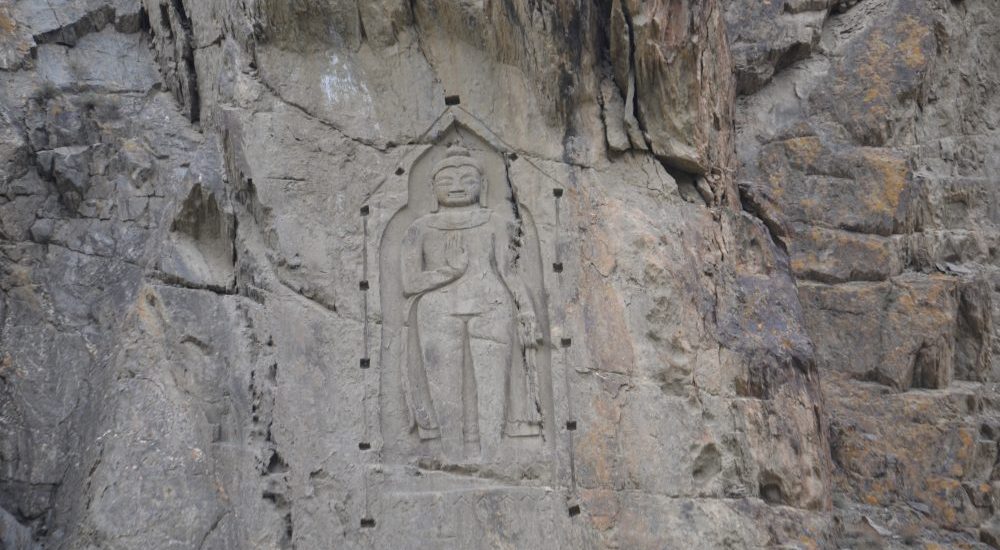
Kargah Buddha: A 7th-Century Marvel Carved in Rock At the center of Gilgit-Baltistan, Pakistan, resides an extraordinary testament to ancient artistry and spirituality – the Kargah Buddha. Carved with precision into solid rock, this majestic Buddha figure from the 7th century stands an impressive 15 feet tall and 5 feet wide, perched about 150 feet above the ground. It is situated in the scenic Kargah Nullah ravine, to the west of Gilgit city. The Kargah Buddha explicitly serves as a symbol of the region’s intricate historical, cultural, and religious heritage. Gilgit: A Hub of History and Trade Gilgit is the headquarters of the Gilgit-Baltistan region of Pakistan. The magnificent city is perched at the confluence of the Gilgit River and Hunza River, near the Junction point of three great mountain ranges. Gilgit’s historical position on the Silk Route has undoubtedly bestowed upon it a legacy of cultural diversity, religious pluralism, and historical significance. The town’s role as a trade hub and cultural crossroads has undoubtedly left a lasting impact on its history. At the same time, the city stands as a testament to the dynamic interactions that shaped the course of history at this strategic crossroads of civilizations. Various phases in the history Gilgit underwent are: Silk Route Connection: As a key point on the Silk Route, Gilgit played a crucial role in the exchange of goods, ideas, and cultures between East and West. The town served as a melting pot where diverse civilizations converged, fostering a vibrant atmosphere of cultural exchange. Buddhism in Gilgit: The period from the 3rd to the 11th century marked Gilgit as a prominent center of early Buddhism. The presence of a Buddhist monastery and stupas with Sanskrit manuscripts attests to the town’s role in the spread of Buddhism. At the same time, the constant movement of religious caravans along the Silk Route contributed to the establishment and growth of Buddhism in the region. Power Struggles: The historical narrative of Gilgit is marked by power struggles among various empires and dynasties, including the Tibetan Empire, the Kashmiri Karkota Dynasty, and the Umayyad and Abbasid caliphates. These political dynamics shaped the region’s destiny and influenced its cultural landscape. Dardistan and Islamization: By the 11th century, Gilgit had evolved into the autonomous kingdom of Dardistan. The adoption of Islam during this period significantly transformed the religious and cultural fabric of the region. The process of Islamization added another layer to the diverse cultural history of Gilgit. Cultural and Religious Interactions: The Silk Route not only facilitated the trade of goods but also enabled the intermingling of cultures and religions. Gilgit served as a meeting point for people from China, Central Asia, Kashmir, Tibet, Afghanistan, Iran, and India. This interaction contributed to the cultural diversity and pluralism that characterize the region. Archaeological Discoveries: The excavation of a Buddhist monastery and stupas with Sanskrit manuscripts in 1931 showcases the rich archaeological heritage of Gilgit. These discoveries provide valuable insights into the town’s historical importance and its connections to early Buddhist communities. Tracing the Buddhist Legacy in Gilgit-Baltistan Gilgit-Baltistan has served as a meeting point for various cultures, religions, and civilizations over centuries. Before the advent of Islam in the area, the inhabitants followed Buddhism or various indigenous pagan religions. The infusion of a diverse cultural legacy and the dissemination of Buddhism in Gilgit and its neighboring areas are intricately connected to the activities along the Silk Route. Historical records indicate that traveling Buddhist caravans would often take respite in a monastery in Gilgit. The Kargah Buddha, known as Yashani in the local language, stands as a testament to this rich historical and cultural intersection. The Karakoram Highway (KKH), which predominantly follows the ancient Silk Route, offers an intriguing glimpse into the past. The KKH attests to the enduring influence of Buddhism in the region. It is adorned with over 10,000 images of Buddha, Stupas, animals, and inscriptions in more than ten languages. This cultural dominance persisted from the 1st to the 7th century A.D. The Kargah Buddha, situated in Gilgit, is an integral part of this rock art ensemble, serving as a symbol of Buddhism’s prevalence in the area. The carving of the Buddha image into the rock was an act of devotion and reverence, with religious rituals and worship conducted at this sacred site. It stands as a testament to the profound impact of Buddhism on the culture and spirituality of Gilgit-Baltistan. The Unearthed History: Kargah Buddha’s Discovery Archaeological evidence spanning across Gilgit Baltistan (GB) indicates that the region was under the influence of Buddhism from the 3rd to the 11th century AD, with Buddhists engraving sculptures, including that of Buddha, as a form of homage to Gautama Buddha. Some historians propose that the propagation of Buddhism in GB occurred during the rule of two Kashmiri monarchs, Yakha and Yakhani. The Buddha sculpture in Kargah is believed to have been crafted in memory of Yakhani by a group of monks. Over time, the term Yakhani evolved into Yashani. Despite these historical accounts, Gilgit’s folklore features numerous myths about the Buddha that challenge both archaeological and historical findings. The revelation of the Kargah Buddha took place in 1938-39, unveiling a sculpture thought to originate from the 4th century AD. Archaeologists unearthed this notable artifact during the same timeframe. The sculpture depicts Buddha with his right hand on his chest in the Abhayamudra, a fearless pose, while the left-hand hangs straight, conveying a message of peace. The image features a broad and squarish face with extended ears, a flat nose, a wide mouth, compressed lips, and hair arranged tightly in a skull-like fashion. The archaeological exploration also led to the discovery of the remains of a Buddhist monastery and three stupas, situated approximately 400 meters upriver from the Buddha. This discovery followed the revelation of the renowned Gilgit manuscripts in 1931. These manuscripts, written in Sanskrit, shed light on local rulers and revered pilgrims. Moreover, the manuscripts offer compelling evidence of a flourishing scholarly community in the region. It is worth noting

Kargah Buddha Read Post »

, , , , , , , , , , , , , , , , ,
Scroll to Top