
Day excursions from Islamabad

Murree Hills
Others

Murree

Exploring Murree: Pakistan’s Premier Hill Station Unlocking the Wonders of Murree, the Enchanting “Queen of Hills” Nestled in the heart of the Peer Panjal Range, Murree, often referred to as the “Queen of Hills,” graces the outskirts of Rawalpindi and Pakistan’s capital, Islamabad. Just 30 kilometers northeast of Islamabad, this hill station, perched at altitudes ranging from 6000 to 7000 feet, captivates visitors year-round. Let’s delve into the rich history and alluring attractions of this picturesque destination. A Glimpse into Murree’s Past Discovering Murree’s Origins In 1847, Major James Abbott, an Indian Army officer, first recognized Murree’s potential as a hill station. Two years later, the decision was made to establish a hill station in this region, providing convenient access from Rawalpindi’s vital military cantonment. It officially took shape in 1851 under the guidance of Sir Henry Lawrence, the President of the Punjab Administrative Board at the time. Originally conceived as a sanatorium for British troops stationed along the Afghan frontier, Murree transformed into a thriving town by 1853. Over time, it acquired a unique blend of British heritage, evident in its churches, educational institutions, and historic landmarks. Notably, several individuals born in Murree during the colonial era, including Lieutenant Colonel Sir Francis Edward Younghusband, Reginald Dyer, and Joanna Kelley, rose to prominence on the global stage. The British Love Affair with Murree The allure of Murree for the British lay in its climate, reminiscent of England, and its escape from the blistering summer heat of Punjab’s plains. Consequently, it became a favored summer retreat for British citizens during the British Raj. However, until 1947, non-Europeans were barred from accessing commercial establishments like Lawrance College and Mall Road. Journeying to Murree In the early 1900s, the journey to Murree from Lahore, the capital of Punjab, involved a train ride to Rawalpindi, followed by a five-hour horsecart ride to Murree. Despite the arduous trip, the hill station buzzed with European visitors and British troops encamped in the hills. The picturesque Victorian Gothic architecture of the houses and villas lent Murree a distinctly European ambiance. By 1901, the permanent population reached 1844, with the summer influx swelling the numbers to potentially 10,000. Post-Independence Transformation Murree continued to enchant as a colonial town until 1947. Today, it stands as a bustling summer resort in the Galyat region of northern Punjab, drawing throngs of tourists every season. The local population, as of 2022, hovers around 233,000, with Pahari as the predominant language. Most local businesses are owned by non-locals. Additionally, Murree serves as a gateway for tourists heading to Muzaffarabad and Abbottabad. It has firmly retained its status as a sought-after hill station since Pakistan’s independence in 1947, attracting visitors from all corners of the country and beyond. Embracing Murree’s Charms Immersing in Nature’s Splendor The Himalayan hills surrounding Murree, adorned with dense evergreen forests and an abundance of flora and fauna, provide an idyllic summer escape. Even in winter, when snow blankets the landscape, Murree’s valleys and mountains captivate visitors from across Pakistan and the world. Here are some must-visit attractions and activities: 1. Patriata Chairlift: Located approximately 20 kilometers from Murree, this chairlift offers panoramic views. 2. Ayubia Chairlift: Another chairlift adventure awaits in Ayubia. 3. Hiking in Nathiagali and Changagali: Explore nature’s beauty on these scenic trails. 4. Stroll from Mall Road to Pindi Point: Followed by a chairlift ride down to Bansra Gali for a memorable experience. 5. Mall Road to Kashmir Point: Revel in the breathtaking views of the Kashmir mountains. 6. Shopping and Dining on Mall Road: Discover local treasures and savor delectable cuisine. 7. Bird and Monkey Watching: Get closer to nature’s wonders. 8. Explore Uppertopa and Lowertopa: Uncover hidden gems. 9. Visit Goragali and Bhurban: Expand your horizons. Unveiling Murree’s Climate Situated in the outer Himalayas, Murree boasts a high-altitude location. The Köppen climate classification categorizes it as having a monsoon-influenced subtropical highland climate. Winters here are cold and snowy, while summers are cool and rainy, often accompanied by fog. Precipitation is a constant companion, with an annual average of 1,904 millimeters and approximately 1,590 millimeters of snowfall, typically from January to March. Navigating to Murree You can access Murree from Islamabad via the old Murree Road or the new Islamabad-Murree Expressway. While there are no railway stations or airports in Murree due to its mountainous terrain, the Islamabad International Airport and Golra Railway Station in Islamabad serve as the closest transportation hubs. Murree, with its rich history, natural beauty, and diverse attractions, remains a jewel in Pakistan’s crown. Whether you’re seeking adventure, relaxation, or simply a break from the ordinary, this “Queen of Hills” offers an unforgettable experience year-round.
Murree Read Post »

, , , , , , , , , , , , , , , , , , , , , , , ,
Islamabad Capital City
Islamabad

Islamabad Capital City

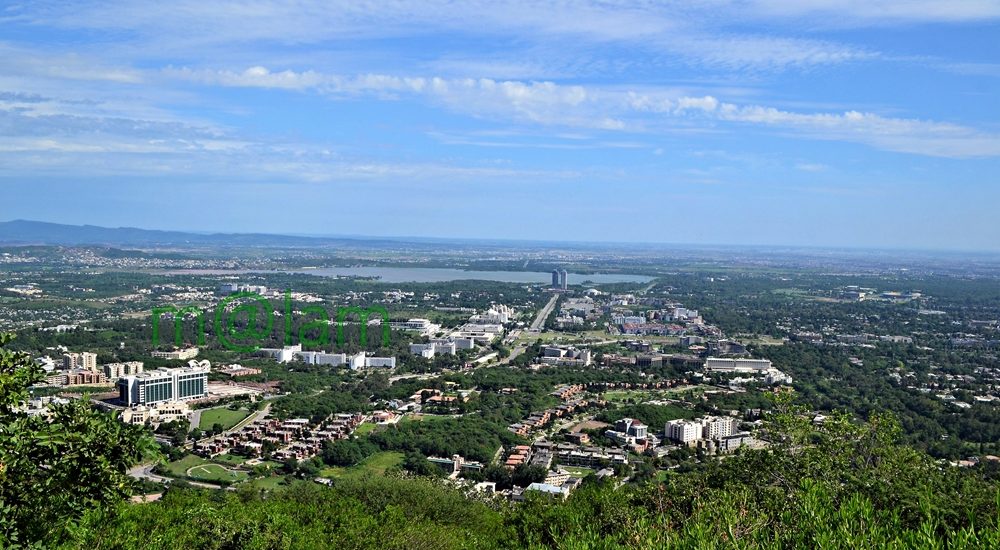
Islamabad – The Capital City of Pakistan Islamabad is the modern capital city of Pakistan. It is nestled in the north of the Potohar Plateau, at the foothill of the Margalla Hills. At an elevation of 507 meters above sea level, this vibrant city is strategically located in the heart of Pakistan. Moreover, the city is equipped with all types of facilities including recreational points, cycling tracks, hiking tracks, shopping malls, restaurants, parks, museums, and exhibition centers. Geographically Peshawar is 185 km (115 mi) to the east, Lahore is 295 km (183 mi) to the north and northeast, Muzaffarabad is 120 km (75 mi) to the south and southwest, and Srinagar, the capital of Indian Kashmir, is 300 km (190 mi) to the west and southwest. Historical Significance of Islamabad Islamabad undoubtedly boasts a rich history. Evidence shows ancient human settlements dating back to the Stone Age. Even some artifacts date as far back as 100,000 to 500,000 years. Moreover, excavations along the banks of the Soan River have revealed relics and human skulls from around 5000 BC. Additionally, the region has historically served as a crossroads between Punjab and Khyber Pakhtunkhwa, with the Margalla Pass acting as a gateway. The emergence of Islamabad as the Capital City After the partition of the subcontinent in 1947, Karachi became the initial capital of Pakistan. However, it was soon realized that Karachi’s location on one end of the country made it vulnerable to attacks from the Arabian Sea. Therefore, the need for a centrally located capital city with a moderate climate and easy accessibility from all parts of the country became evident. In 1958, the commission responsible for selecting the capital city chose the area that would become Islamabad. The selection was made by considering its proximity to the army headquarters in Rawalpindi and the disputed territory of Kashmir in the north. Development and Layout The construction of Islamabad as a forward capital began in 1960. Planned by a Greek firm of architects called Konstantinos Apostolos Doxiadis, the city follows a grid scheme and is triangular, with its apex facing the Margalla Hills. The capital territory is further divided into eight zones. Each zone is particularly designated for specific purposes like administrative, commercial, educational, industrial, and diplomatic activities. Moreover, The residential areas, rural zones, and green spaces provide a harmonious living environment. The city’s layout is well-organized, with lettered sectors from A to I, each further divided into four numbered sub-sectors. Therefore, clear demarcation makes navigation easy and allows for convenient addressing. Climate and Environment Islamabad experiences a unique climate characterized by hot summers with a monsoon season and mild winters. Three artificial reservoirs, including Rawal Lake, Simli Dam, and Khanpur Dam, regulate the city’s micro-climate. For instance, summers, from May to July, are the hottest months, with temperatures averaging around 40 degrees Celsius. Likewise, the monsoon season, spanning July through September, brings heavy rainfall and thunderstorms. Notable was July 1995 recorded the highest monthly rainfall of 743.3 millimeters (29.26 in). Winters, from October to March, vary in temperature depending on the location, with the lowest recorded temperature of -6 degrees Celsius occurring on January 17, 1967. Things to Do in Islamabad Islamabad offers a plethora of exciting activities for visitors and locals alike. Some popular Tourist Attractions in Islamabad to be explored include: Hiking Trails The city offers a network of specially designed hiking trails. Major hiking trails are Trail 1, Trail 2, Trail 3, Trail 4, Trail 5, and Trail 6, besides Saidpur Trail and Bari Imam Trail, catering to outdoor enthusiasts. Museums and Tourist Places History lovers and culture enthusiasts can explore the various museums and tourist attractions within Islamabad. Fishing in Rawal Lake Fishing enthusiasts can enjoy their favorite pastime in the picturesque setting of Rawal Lake. Paragliding on the Margalla Hills Thrill-seekers can experience the exhilaration of paragliding while taking in breathtaking views from the Margalla Hills. Cycling Designated cycling routes across Islamabad provide an excellent opportunity for cyclists to explore the city’s scenic beauty. Day Excursions from Islamabad Visitors can venture to nearby attractions in the nearest destinations in Punjab, KPK, and Kashmir as memorable day excursions from Islamabad. Shopping Delights Islamabad’s well-planned layout includes central shopping malls in each sector. The city offers a wide range of local and international brands at reasonable prices. The popular markets, such as F6 Markaz (Supermarket), F7 Markaz (Jinnah Super Market), F8 Markaz (Ayub Market), G6 Markaz (Melody Park), and G9 Markaz (Karachi Company), each have their distinct charm and shopping options. Culinary Adventures The city of Islamabad boasts a diverse culinary scene, catering to various tastes and preferences. From star hotel restaurants to international chains and local food joints, visitors can savor Chinese, Thai, Italian, and local cuisines, among others. How to Reach Islamabad By Air Islamabad can be reached via the Benazir Bhutto International Airport (IATA: ISB). Flights arriving from numerous international destinations include Dubai, Qatar, Abu Dhabi, London, Thailand, Sri Lanka, and China. By Bus Well-established local transport companies, such as Skyways, Faisal Movers, Niazi Express, and Daewoo Sammi, offer international standard long-haul bus services. Moreover, direct travel is available from major cities in Pakistan, including Karachi, Multan, Bahawalpur, Faisalabad, Lahore, and Peshawar. Additionally, these companies have arrangements made to transport passengers to offices within the twin cities. By Train Rawalpindi is well-connected by train to major cities, making it possible to reach Islamabad by train. Islamabad, with its rich history, well-planned layout, and diverse offerings, obviously stands as a testament to Pakistan’s progress and development. From its fascinating historical sites to its modern amenities and attractions, Islamabad invites visitors to explore its beauty and charm. Whether one seeks adventure, cultural experiences, or simply wants to enjoy a relaxing time in a dynamic city, Islamabad has something to offer for everyone.

Islamabad Capital City Read Post »

, , , , , , , , , , , , , , ,
Scroll to Top