Gilgit-Baltistan
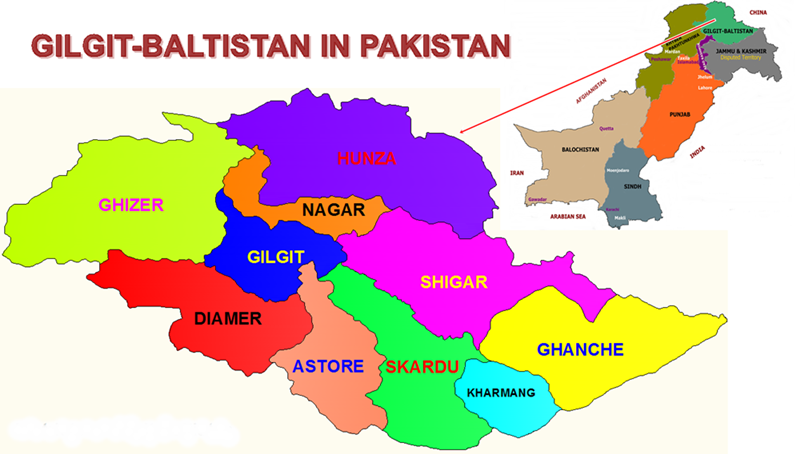
Gilgit-Baltistan: Nature’s Paradise and Cultural Diversity Gilgit-Baltistan, nestled in the northernmost reaches of the world, boasts some of the planet’s loftiest peaks and most extensive glaciers outside the Polar Regions. In addition to its awe-inspiring natural beauty and impressive man-made landmarks, this region is home to over 1.7 million people making a rich tapestry of ethnic groups, each proudly preserving its own culture and language. It has earned worldwide recognition as a top tourist destination and was historically referred to as the Northern Areas of Pakistan. Geographical Wonders Gilgit-Baltistan spans an impressive 72,971 square kilometers (28,174 square miles) and is bordered by China’s Xinjiang province to the east and northeast, Afghanistan’s Wakhan Corridor to the north, Pakistan’s Khyber Pakhtunkhwa province to the west, and the Indian-administered state of Jammu & Kashmir to the south. Geologically, this region is marked by instability, as it serves as the convergence point of the Indian and Eurasian tectonic plates. The Indian plate’s northward movement at an average rate of 7mm per year has given rise to the majestic Nanga Parbat. Divisions & Districts Gilgit-Baltistan consists of three primary divisions: Gilgit, Baltistan, and Diamer. These divisions further house ten distinct districts. Gilgit division comprises Gilgit, Hunza, Nagar, and Ghizer; the Diamer division encompasses Diamer and Astor districts; and the Baltistan division incorporates Skardu, Shigar, Kharmang, and Ghanche districts. A Glimpse into History Throughout history, Gilgit-Baltistan has functioned as a pivotal intersection for ancient trade routes, fostering a blend of diverse ancient civilizations. The region has sustained its significance as a prominent Buddhist center of learning for numerous centuries. The Silk Route, a segment of the extensive network of ancient Silk Routes, has transformed into the modern-day Karakoram Highway (KKH). The highway boasts over 50,000 petroglyphs and inscriptions situated between Hunza and Shatial. Left behind by a variety of travelers, including invaders, traders, and pilgrims traversing the upper Indus, these carvings tell the tale of the region’s rich history. Among the earliest known carvings, dating back to 5000-1000 BCE, are depictions of triangular men, hunting scenes, and single animals, typically larger than the depicted hunters. Gilgit-Baltistan maintained its independence until the 19th century when British colonization occurred. The region was fragmented into numerous mountain principalities during this period. Under colonial rule, it fell under the dual control of the British Indian Government and the state of Jammu & Kashmir. Following the partition of the Indian subcontinent and the establishment of Pakistan, a local uprising overthrew Kashmir’s rule, declaring independence. Since then, the area has been administered by Pakistan, operating directly under the federal government. Rich Culture & Heritage People The inhabitants of Gilgit-Baltistan are widely recognized for their friendliness, hospitality, and resilience. They share a profound connection to their homeland, fostering a robust sense of community over the years. Given the geographical remoteness and challenging topography of the region, the locals have adapted to the rugged mountainous environment, acquiring distinctive skills such as mountaineering and trekking. Hailing from diverse ethnic backgrounds, the people of Gilgit-Baltistan belong to major ethnic groups like the Baltis, Shins, Yashkuns, Dards, Burushos, and others. Each group possesses its own set of customs, traditions, and languages, contributing to the rich cultural tapestry of the region. Clothing The residents of Gilgit-Baltistan showcase a distinctive traditional attire that mirrors their cultural legacy and adapts to the challenging climate of the region. In professional settings, educational institutions, and business-related engagements, individuals opt for modern and fashionable clothing. Nevertheless, a significant number of men choose to don the traditional Pakistani attire, Shalwar Qameez, often accompanied by a woolen waistcoat and cap in colder weather, while the winter months may see the use of a Choga, a long woolen robe embellished with embroidery. Among females, especially the younger generation, there is a preference for trendy and stylish dresses, whereas more conservative women still find comfort in the traditional combination of shalwar kameez and dupatta. During ceremonial occasions, both men and women tend to gravitate towards traditional attire. Religious Affiliation The inhabitants of Gilgit-Baltistan adhere to diverse religious beliefs, showcasing the variety present in the region. While the majority of the population practices Islam, a significant portion follows the Shia sect. In addition to Sunni Muslims, there are also Ismaili Muslims and Noorbakhshi Muslims in Gilgit-Baltistan. Furthermore, small communities of Christians and followers of the Sikh faith contribute to the religious tapestry of the region. The religious composition of Gilgit-Baltistan is characterized by its diversity, as people of different faiths coexist and play a role in shaping the cultural landscape of the area. Arts & Crafts The traditional arts and crafts of Gilgit-Baltistan are a testament to the creativity, expertise, and cultural identity of the local communities. Widely recognized for their craftsmanship, the region is particularly celebrated for the production of exquisite hand-woven carpets, skillfully made using traditional techniques passed down through generations. Artisans in Gilgit-Baltistan showcase their proficiency in woodwork, producing intricate carvings on various wooden items. Traditional wooden furniture, decorative panels, doors, and utensils feature delicate designs that highlight local motifs, flora, and fauna. Additionally, basketry stands out as a traditional craft in Gilgit-Baltistan, where adept artisans weave baskets and containers using locally available materials like willow. These baskets serve various purposes, including storage, transportation, and aesthetic decoration. Given the cold climate, woolen textiles hold significant importance in the region’s arts and crafts. Handcrafted woolen shawls, blankets, and caps feature intricate patterns and designs, often incorporating vibrant colors. Enriching Culture The society of Gilgit-Baltistan is diverse in terms of language, religion, and ethnicity. The culture of Gilgit-Baltistan is heavily influenced by its geographical location, nestled amidst the majestic mountains of the Karakoram and Himalayan ranges. The region’s isolation and rugged terrain have helped preserve its distinct cultural practices and way of life. Gilgit-Baltistan is home to various ethnic groups, including the Shina-speaking Indo Aryans /Dardic people (Yashkun, Shin, Dom, Kamin), the Brusho of Hunza and Nagar, the Tibetans of Baltistan (Skardu, Ghanche, Shigar, and Kharmang), and Wakhi people along the Pamirs (living in Upper Hunza