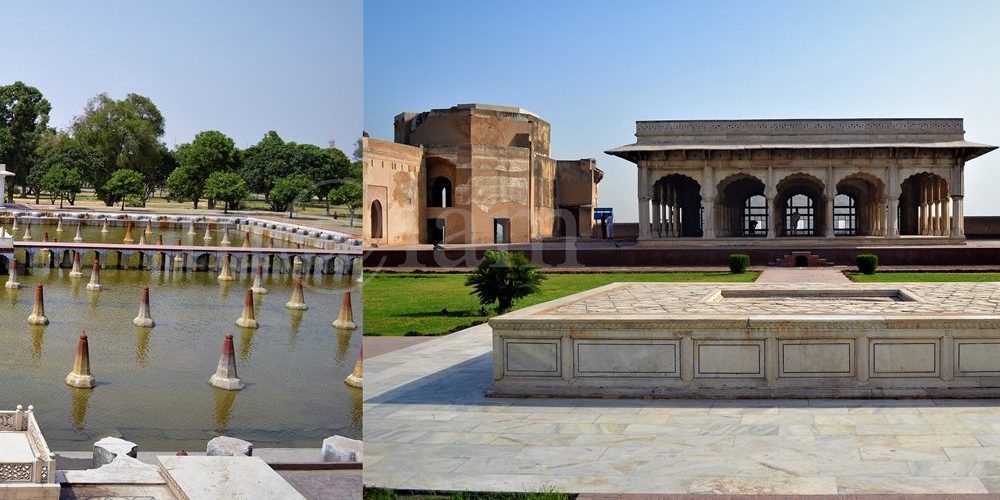

Hidden Treasures of Lahore
Lahore is the second largest city and the cultural hub of Pakistan. The city has a charming longstanding history and is entirely rich in tourist attractions, mostly of historic and cultural significance. However, sadly, only a few conventional landmarks out of a cluster are known to the general public and tourists. The “Hidden Treasures of Lahore” have not yet been unearthed properly. The wealth of attraction that is still hiding behind deserves to be known to the public and tourists which certainly will add to the historic significance of Lahore. Wazir Khan Baradari The Wazir Khan Baradari (12-door pavilion) is sited between the Punjab Public Library (PPL), the National College of Arts (NCA), and the Lahore Museum and is accessible from the PPL road. It was named after Hakim Ilumddin titled ‘Wazir Khan’, a benefactor of numerous impressive buildings across Lahore including the splendid Wazir Khan’s Mosque and Wazir Khan’s Hammam ( also known as Shahi Hammam), in the Walled City. The Baradari is surrounded by a fine garden with a large number of palm trees. The two-story pavilion has been incorporated into the grounds of the Punjab Public Library in 1860 and serves as a reading room. During the 19th and early 20th centuries, Wazir Khan Baradari was used as a museum and as the Settlement and Telegraph Office under British rule. Maryam Zamani or Begum Shahi Mosque or Barood Khana Wali Masjid Maryam Zamani was one of the queens of Emperor Akbar, mother of Jahangir, and sister of Bhagwan Das. She built a mosque near Masti Gate of the Walled City in 1614 AD and is believed Lahore’s earliest surviving example of the Mughal era mosque that influenced the construction of the larger Wazir Khan Mosque. Thus it was named after the queen Maryam Zamani who was actually born Rajkumari Hira Kunwari, a Rajput princess, the daughter of Raja Bihari Mal of Jaipur (the then Amber). The mosque has a beautifully adorned prayer hall with a remarkable central dome adorned by muqarnas and painted frescos. The Mosque is close to the Akbari gate entrance and was once used as a gunpowder factory by Ranjit Singh thereby called Barood Khana Wali Masjid. However, it was restored in 1850 under the British. Ali Mardan Khan’s Tomb Ali Mardan Khan was originally a noble at the court of Shah Tahmasp, a Safavid king. After surrendering Iranian Qandahar to Emperor Shah Jahan in 1638, he joined the Mughal court and rose to great heights rapidly and became Governor of Kashmir, Lahore, and Kabul. He was also granted the title of Amir al-Umara (Lord of Lords) in 1639 and became a commander of 7,000 troops as well was appointed viceroy of Punjab from Kabul to Delhi. Besides being a commanding figure, Ali Mardan Khan was also a renowned engineer who coined the idea of the construction of a canal from the river Ravi for the supply of water to the Shalimar Gardens, as well as for the irrigation and cultivation of surrounding areas. His tomb is a massive brick construction work standing on an octagonal podium. The structure of the tomb is also octagonal with a bulbous dome and kiosks on angular points. The tomb once stood in the center of a luxuriant garden and the extent of which could be seen by its double-story gateway. The imposing tomb is accessible by a 300 m-long walkway through the narrow streets of the Railway Carriage Workshop. Saru Wala Maqbara or Cypress Tomb The tomb of Sharf-un-Nisa Begam is popularly known as ‘Saru Wala’ Maqbara. Saru is the Urdu term used for Cypress and because of images of cypress trees used on its walls, it is thus called Cypress tomb. Sharf-un-Nisa Begam was a sister of Nawab Zakariya Khan, governor of Lahore province during the reign of Emperor Mohammad Shah Rangeela. Before her death, the Begum would read the holy Quran on daily basis on the first floor of the Chamber and then would deposit the holy book and the jeweled sword, descending by means of a portable wooden stair. After her death, she was buried in the same chamber along with a copy of the holy Quran and her jeweled sword. The unusual tower-like tomb is 16 feet above the ground and was made inaccessible by blocking up all openings in 1745. It is located near the north of Dai Anga’s tomb in the Begumpura neighborhood of Lahore. The structure of the tomb is unique in itself for its unusual shape and decoration of the cypress motif as a jewel of Mughal architecture. Dai Anga’s Tomb Dai Anga, the wet nurse of Mughal Emperor Shah Jahan and his daughter (Princess Sultan Begum), was the name given to Zeb-un-Nisa (1671 AD). She was the wife of a Mughal noble Murad Khan, magistrate of Biknar under Jahangir. Her splendid mausoleum lies near the Gulabi Bagh gateway in Begampura, outside the Walled City. The rectangular-shaped mausoleum with eight rooms encircling the perimeter of a central chamber lies on a raised plinth. A dome with frescoes is directly above the central empty chamber as the actual tomb of Dai Anga lies below in the basement just next to her daughter, Sultana Begum. The interior of the tomb is richly decorated with carved inscriptions from the holy Quran while the exterior with rich Kashi Kari or Qashani tilework but lost much of its charm. Dai Anga Mosque The real name of Dai Anga was Zaib-u-Nisa, the wife of Mughal noble Murad Khan. She was the wet nurse of Shah Jahan and his daughter and remained a powerful figure in the Mughal dynasty. Several charming monuments associated with her name are still surviving in Lahore. Dai Anga Mosque was constructed in 1635 AD and is located near Lahore Railway station. Small in size yet rich in decor, the Dai Anga Mosque is embellished with multicolored mosaic on floral themes and remained in excellent condition since Dai Anga donated a substantial endowment to ensure its maintenance even after her death.
Hidden Treasures of Lahore Read Post »