
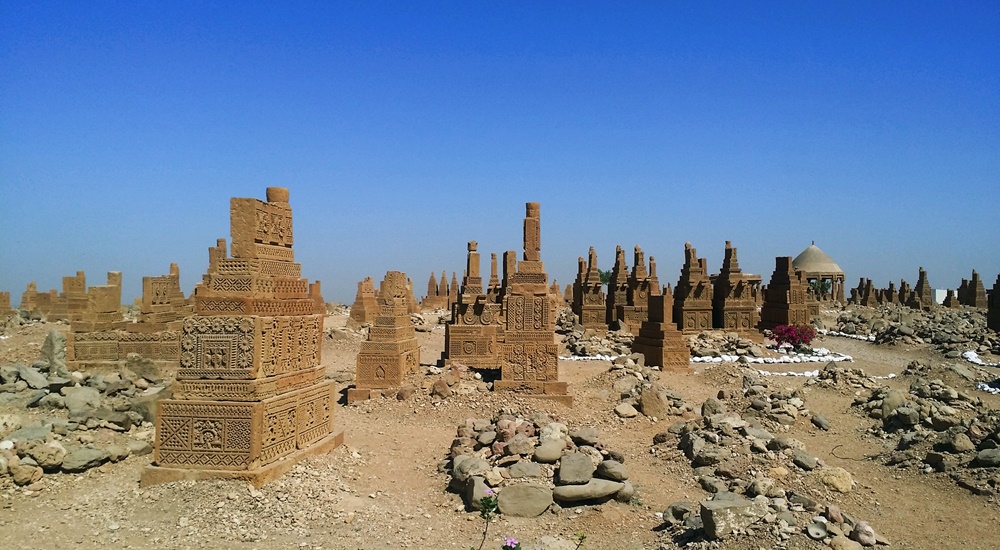
Chaukandi Tombs
Expanding across a two-square-mile area, the Chaukandi Tombs near Karachi form an ancient Islamic burial site. The Chaukandi Tombs are renowned for its detailed sandstone carvings. These tombs bear a stylistic similarity to the elaborate graves located at the Makli Necropolis, one of the six UNESCO World Heritage Sites, near Thatta. Displaying the distinctive funerary architectural style typical of lower Sindh, the Chaukhandi Tombs undoubtedly provide a fascinating insight into the historical and artistic legacy of the region. History of Chaukandi Tombs: The Chaukhandi graveyard is attributed to the Jokhio tribe of Sindh. At the same time, other Sindhi tribes like Burfat, Jakhra, and Shaikh tombs are also found. The graveyard was constructed during the Mughal rule from the 15th to the 18th century, a period dominated by Islam. In addition to the Jokhio tribe, various Baloch tribes with Rajput origins have found their final resting place here. The influence of the Rajput tribe is evident in the design of the tombs. The step-shaped graves basically showcase a blend of cultures. For instance, some graves feature Rajput characteristics like monumental pedestals and slabs, while others exhibit simpler decorations, resembling a child’s drawing of a human face. Likewise, some tombs lack any human figures, reflecting Islamic beliefs and contributing to the diverse historical tapestry preserved in the Chaukhandi necropolis. The majority of the tombs at Chaukhandi especially represent family graveyards. However, only a limited number placed beneath pillar canopies that exhibit a Hindu architectural style. On certain male graves, intricate carvings depict a horseman equipped with arms such as a shield, sword, bow, and arrow. Meanwhile, carvings on women’s graves portray ornamental details like bracelets, necklaces, rings, anklets, and more. Additionally, for male graves, a boss-shaped projection at the northern end is designed to secure the turban of the deceased. These detailed carvings provide insights into the cultural and personal attributes of the individuals interred at Chaukhandi. Design of Chaukandi Tombs: The tombs at Chaukhandi stand out as a distinctive illustration of surface burials. Unusually aligned from south to north, a departure from the norm in both the region and period, these tombs are crafted from substantial sandstone slabs intricately arranged to form refined pyramid shapes. The meticulous carving on these slabs showcases intricate patterns, drawings, and scenes that contribute to the unique artistic and historical significance of the Chaukhandi Tombs. The absence of precise dating inscriptions on the Chaukhandi Tombs makes it challenging to determine their exact historical timelines. A typical casket consists of six vertical slabs, with two placed at the head and foot of the grave and the remaining four covering the sides, accommodating the length of the body. The tomb takes on a pyramid-like shape, featuring six large slabs covered by another tomb comprising six smaller vertical slabs. The architecture of Chaukandi Tombs: These tombs explicitly represent a unique blend of Sindhi and Balochi architectural styles. Crafted from beige-colored sandstone, these tombs come in the form of single graves or clusters, containing up to eight tombs. Despite the challenges posed by the region’s arid climate, these tombs have endured, serving as a resilient testament to the culture and heritage of the area. Chaukhandi Tombs, a form of funerary architecture, are characterized by square-shaped structures. Its five horizontal slabs enclosing the upper part of the tomb. Notably, these structures often exhibit a carved knob resembling a crown or turban at the front. Graves of warriors from the tribe boast intricate designs and motifs, including depictions of horsemen, jewelry, and hunting scenes. In contrast, tombs of women showcase carvings of anklets, bracelets, and jewelry at the front rather than human figures. Men’s graves typically feature carvings of swords, symbolizing their role as protectors of the tribe during times of war. Distinctive Features of Chaukandi Tombs: The Chaukhandi Tombs exhibit several distinctive features: The most prominent visual characteristic of Chaukhandi tombs is their cone-shaped roofs, constructed using bricks or stones and mortar. This design choice was made to distribute the weight of the structure over a larger area, enhancing stability and durability. The walls of Chaukhandi tombs are built in a beehive formation. The tombs feature multiple layers of stones arranged in a stepped pyramid shape. Constructed from local stones and bricks, these walls often bear decorative designs. Inside each tomb, there is typically a dedicated prayer chamber. This space actually serves for mourning and remembrance of the departed. Accompanying every tomb is a raised grave platform, situated above the surrounding landscape. This platform serves as a place for the family of the deceased to conduct rituals related to the burial. Discovery of Chaukandi Tombs: The Chaukhandi Tombs gained historical recognition with the earliest reference found in a letter written by J. Macleod, a Scottish historian, to Sir Henry Bartle Edward Frere, a British administrator, in 1851. However, it was H. D. Baskerville, the Assistant Collector of Thatta in Karachi in 1917, who brought these historical graves into prominence. In 1922, the site was officially included in the Ancient Monuments Preservation Act. Jean Philippe Vogel, a distinguished Dutch epigraphist employed by the Archaeological Survey of India from 1901 to 1914, played a crucial role in shedding light on the tombs. His extensive research revealed that many of these tombs belonged to Muslims. It was evident from the Arab script inscribed on their graves. Vogel’s findings provided valuable historical insights into the religious heritage of India. Post-independence, scholars and historians continued their in-depth investigations into the Chaukhandi Tombs. Rubbings of these tombs were displayed globally, capturing the attention of academics and sparking further research into this significant archaeological site. Recommendations: Chaukhandi Tombs are highly recommended to visit for individuals passionate about archaeology and history. The site holds a wealth of historical narratives. If you’re intrigued, plan your visit to this amazing site. Apart from the rich decoration adorning the tombs, another noteworthy aspect shared with similar necropolises worldwide is the prevalent local belief that the area is haunted. The Chaukhandi Tombs are reputed to be one of the most haunted sites in the
