Khyber Pakhtunkhwa Province
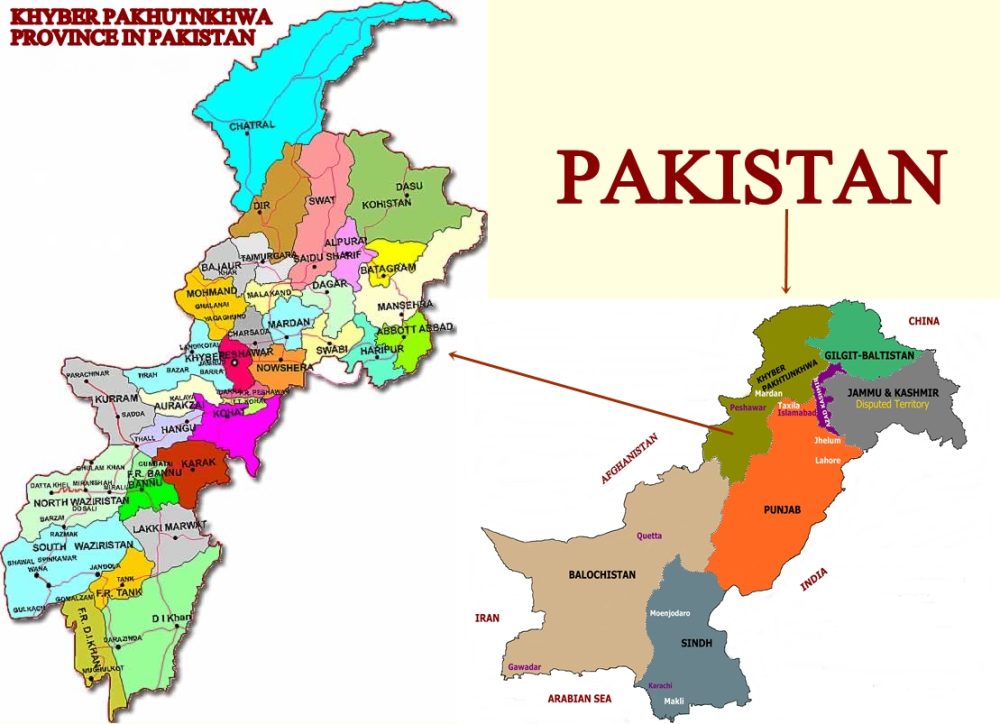
Khyber Pakhtunkhwa Province of Pakistan The Khyber Pakhtunkhwa Province is the smallest of the four administrative provinces of Pakistan. It is located in the northwest of the country housing some 35.53 million (2017 census) people in a 101,741 km² landmass. The province is the third largest by population and economic contribution. It was formerly called the North West Frontier Province (NWFP). Later in 2010, it was renamed Khyber Pakhtunkhwa Province (abbreviated as KPK). Peshawar is the provincial capital and the largest city. Geography Geographically, Afghanistan makes up the 1100 km long northwestern border of the Khyber Pakhtunkhwa Province, Gilgit-Baltistan is located to the northeast; the Federal Capital of Islamabad, Azad Kashmir, Punjab covers the southeastern section, and the northern tip of Balochistan makes up the southern border of the province. Major Cities The province of Khyber Pakhtunkhwa has 35 districts and 46 cities. Peshawar is the provincial capital and the largest city in the province. Major cities and towns of Khyber Pakhtunkhwa are Abbottabad, Bannu, Barikot, Charsada, Chitral, Haripur, Mardan, Mingora, Mansehra, Nowshera, Peshawar, and Saidu Sharif. A Journey Through History The region making today’s Khyber Pakhtunkhwa Province has for centuries been a doorway to the subcontinent. Its unique landscape and strategic location made it home to the grand civilizations of history. The region making Khyber Pakhtunkhwa has historically remained a stronghold of Buddhism. It was characterized by successive invasions under various empires because of its proximity to the Khyber Pass. Persians, Greeks, Mauryans, Kushans, Shahis, Ghaznavids, Mughals, Afghanistan, Sikhs, and the British Empire have all left strong imprints at various points in history. Today, the ruins of the ancient kingdom of Gandhara, including its capital Pushkalavati near modern-day Charsada, spread in major areas of the province making it one of the most alluring regions of the world. Takht-e-Bahi, one of the six UNESCO World Heritage Sites in Pakistan, is located in the province of KPK. The entire region is abundant in tourist attractions that have a universal significance. Culture and Heritage People The region is home to 11.9% of Pakistan’s total population of the country. The majority of the inhabitants are Pakhtuns or Pashtuns followed by Hazarewal, Chitrali, Kalash, and Gujjars. Pashtun or the Pathans being the majority in number (more than 75%) are the dominant groups in the province. They are very well known for their bravery, loyalty, and gallantry. Most of the disputes are settled in the Jirgah system headed by the tribal elders of the society. Major tribes included Yusufzai, Bangesh, Khattak, Marwat, Afridi, Orakzai, Mohmand, Mahsud, Wazir, Bannuchi, Bhittani, Daavi, Qazi Khel, Gandapur, and Ghargasht. The non-Pashtun tribes living in the province are Jhut, Mughal, Turks, Rajputs, and Abbasi Syeds. According to Thomas H. Jhonson and M. Chris Mason in “No Sign Until the Burst of Fire”, “Pashtun believes that their social code produces men, who are superior to those under the Western model, and they have no desire to have a new social system imposed on them by outsiders”. Clothing The traditional dress of Pashtun men usually comes in Shalwar Qameez (Partoog-Korteh in Pashtu) with a Turban. The Turban with an upright flap is considered a symbol of honor. However, the Turban is usually worn by old men. The new generation either wears a topi or kufi which is also unique to the Pashtuns. Besides Khyber Pakhtunkhwa and Quetta, Pashtuns in Afghanistan have almost the same dress code. Since they have a strong tribal-based society, the tribe leaders usually wear a Karakul hat. Peshawari Chappal is the traditional footwear not only famous in Khyber Pakhtunkhwa but across the country. Women in urban areas are dressed as per existing trends. However, in rural areas of Khyber Pakhtunkhwa, women wear Burqa to cover the entire body. Religious Beliefs The majority of the residents of the Khyber-Pakhtunkhwa are followers of Islam. However, the tribes of Kalash in southern Chitral still have been able to retain their ancient Greco-Animist religion. Moreover, there are very small numbers of adherents of the Roman Catholicism sect of Christianity, Hinduism, and the Sikhism Arts & Craft Major arts and crafts of the province included woodwork, Chappal making, stone jewelry, vessels of brass and copper, hand-woven woolen fabrics, leatherwork, hand-knotted rugs, carpets, and caps made of wool, etc. Culture Pashtu culture is based on Pashtunwali. It is an ancient way of life characterized by the use of pure Pashtu language and wearing traditional dress. Besides the dress code, Pashtu poetry, folk music, and traditional dances are a great part of the rich culture of the Pashtuns. People still live in the joint family system and the arranged marriage system is part of the culture. Historically, the Pashtu culture traces its roots back to the time of Alexander the Great. However, over the centuries, the Pashtun culture has to some extent been influenced by the people of south and western Asia. The Hindko culture has many resemblances with the Pashtu culture, however, the Chitrali and the Kalash tribes have entirely different patterns. The Kalash people have their own architecture, rituals, folktales, and musical instruments. The Chitrali people have their own distinct set of cultural values resemblance to those of Gilgit-Baltistan. Languages Pashtu is the provincial language of Khyber Pakhtunkhwa spoken by the majority (more than 75%) of the total population as the first language. Hindko, Saraiki, Khowar, Kohistani, Kalasha, and Gojri are the secondary languages spoken by different ethnic groups in the regions they are residing in. Urdu, the national language, is a medium of communication in educational institutions and is spoken for official communication while English is used for official correspondence and is also taught in academic institutions. Arabic is used for religious purposes and education. The provincial government, in 2011, approved the introduction of Pashto, Hindko, Saraiki, Khowar, and Kohistanis as compulsory subjects for the schools in the areas where they are spoken. Food The cuisines of Khyber Pakhtunkhwa are famous across Pakistan as Chinese food is famous around the world. These devoted and hardworking individuals value the importance of good
Khyber Pakhtunkhwa Province Read Post »