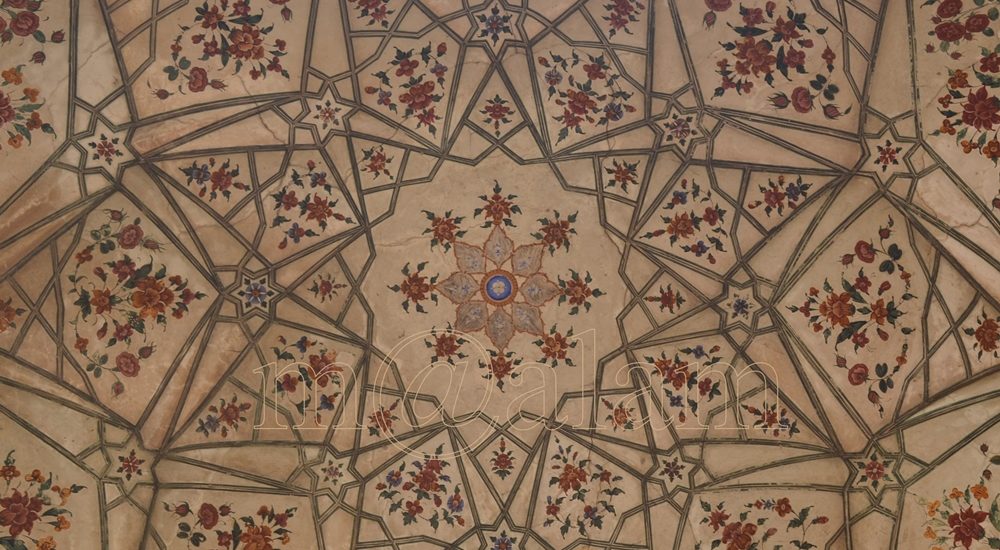
Lahore

Tentative list of UNESCO World Heritage Sites of Pakistan
Blogs, Heritage Sites in Pakistan, World Heritage Sites

Tentative List of UNESCO World Heritage Sites of Pakistan

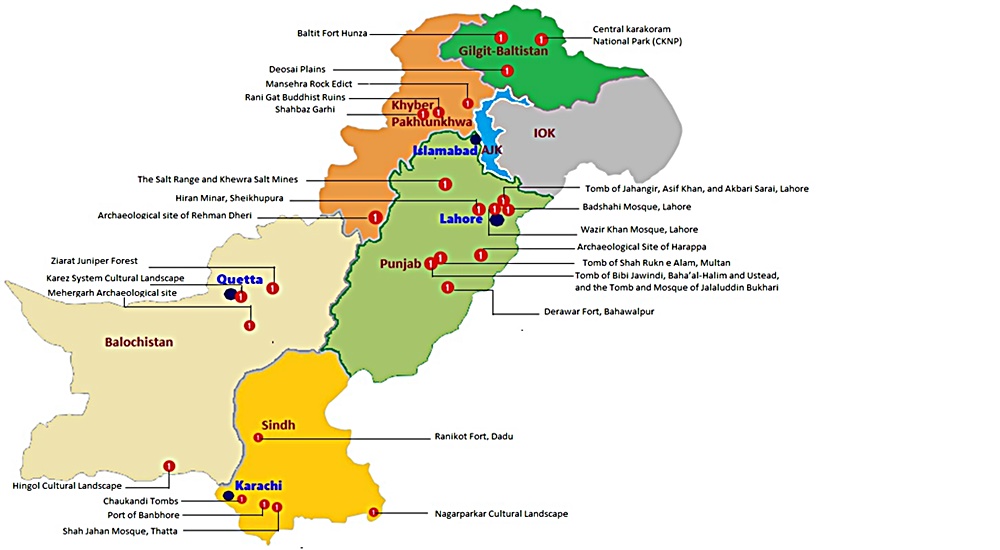
Tentative List of UNESCO World Heritage Sites of Pakistan Pakistan boasts six UNESCO World Heritage Sites. In addition to these established sites, the country has compiled a roster of 25 potential sites called the Tentative List of UNESCO World Heritage Sites of Pakistan seeking recognition. This catalog has been formally presented to the UNESCO Committee for assessment and approval. The pre-listing process is a mandatory step for the eventual acceptance of nominations onto the esteemed World Heritage list. Punjab Province The Salt Range and Khewra Salt Mine The Salt Range, rising abruptly from the Punjab plains in Pakistan, spans 180 km and features sheer escarpments, jagged peaks, and fertile valleys. Originating 800 million years ago, it formed from the evaporation of a shallow sea and underthrusting of the Indian Plate. Named for the thickest rock salt seams globally, the range is a geological treasure with fossiliferous stratified rocks and exposed strata, attracting global geologists. The region is rich in paleontological finds, including dinosaur trackways, Cretaceous belemnites, and ancient hominid remains. The Salt Range is a historical and cultural hub with sites dating from Alexander the Great‘s era to the British colonial period. Notably, Khewra hosts one of the world’s richest salt deposits, exploited for over a millennium, continuing as a mining, research, and tourism center. Badshahi Mosque, Lahore The Badshahi Mosque and its expansive courtyard are elevated on a platform accessible from the east via a grand staircase and a traditional Mughal-style gateway. The entrance, a two-story structure, boasts intricate decorations with framed and carved paneling on all facades. Square minarets with pseudo-pavilions in red sandstone and white marble cupolas adorn the four corners. Its tall octagonal minarets are positioned at the courtyard’s corners. Additionally, smaller octagonal minarets are attached to the prayer chamber’s corners, beneath three grand marble domes. The red sandstone exterior is subtly adorned with white marble inlay lines and patterns. The interior and exterior of the prayer chamber feature unique and beautifully crafted Zanjira interlacing and floral motifs in bold relief, showcasing unparalleled beauty and craftsmanship in Mughal architecture. The gateway’s inscription indicates its construction in A.H. 1084 (1673-74 A.D.). Wazir Khan Mosque, Lahore The Wazir Khan Mosque, covering an area of 279′ x 159′, is entirely constructed using cut and dressed bricks laid in kankar lime, with minimal use of red sandstone in the gate and transept. The courtyard is split into two sections, with the upper part slightly elevated and an ablution tank in the middle. Flanking the east, north, and south sides of the courtyard are 32 small hujras of varying sizes. The prayer chamber on the west side features five compartments divided by massive piers supporting wide, four-centered arches, each topped with a dome. Small rooms are created at the northern and southern ends, and an eastern gallery leads to a spiral staircase accessing the roof. Distinctive structural elements include four corner minarets, five domes, and a transept at the entrance gate on the east. According to inscriptions, the mosque was built in A.H. Archaeological Site of Harappa The archaeological site of Harappa, extending over 150 hectares, comprises eight mounds and two cemeteries situated to the south of the dry Ravi riverbed. While much of the site is buried beneath agricultural land or the modern village of Harappa, exposed structures on mounds AB and F date back to the third millennium BC. The site’s sequence spans from the fourth to the second millennium BC, with a depth of over 13 meters. The strategic location beside the old course of the Ravi River granted inhabitants access to trade networks, aquatic resources, and water for cultivation, explaining its prolonged occupation. Harappa’s town plan during the mature Harappan period (2600-1900 BC) features self-contained walled centers on raised mounds. The site’s unique urbanization declined in the second millennium BC, and subsequent developments, including brick removal for railway ballast in the 1850s and salination from irrigation agriculture, impacted the preservation of structures. Tombs of Jahangir, Asif Khan and Akbari Sarai, Lahore The Tombs of Jahangir, Asif Khan, and Akbari Sarai, designated on December 14, 1993, showcase remarkable Mughal architecture. Jahangir’s Tomb is a single-story structure with a square plan, featuring tall octagonal corner towers and a projecting entrance bay on each side. The exterior boasts red sandstone facing with intricate marble inlay decoration. The interior displays floral frescoes, delicate inlay work (pietra dura), and vibrant marble intersia. Asif Khan’s Tomb, an octagonal structure with a high bulbous dome, stands in a vast garden. Originally adorned with rich stone inlay and bold stucco tracery inside, it featured a high bulbous double dome covered with marble veneering. Akbari Sarai, between Jahangir and Asif Khan’s, includes an open courtyard with small cells, adorned gateways, and a mosque with three splendid domes. The Sarai and the entrance gateway seem part of a unified complex from Shah Jahan’s era, sharing similar styles and elements. Hiran Minar and Tank, Sheikhupura The Hiran Minar, erected under Emperor Jahangir’s reign in 1620 AD, boasts unique architectural elements. Its facade sports 210 square perforations arranged in 14 rows, while inside, a spiral staircase with 108 steps leads to the top, adorned with 11 rectangular arched openings. Divided into six tiers, the Minar showcases lime plaster possibly embellished with floral or linear frescoes. An arched entrance graces the lowest tier. Across from it lies a rectangular tank connected by a causeway to an octagonal baradari. Each corner features square pavilions with gateways. The tank, equipped with ramps, parapet walls, and staircases, connects to the Aik rivulet via a channel. Inside the baradari, intricately decorated niches and honeycomb patterns adorn the walls. The causeway, supported by 21 pointed arched pillars, links the main baradari to an octagonal platform in the tank’s center, which served as a royal residence. Tomb of Hazrat Rukn-e-Alam, Multan The tomb of Shah Rukn-i-Alam, constructed between 1320 and 1324 AD by the Tughluq ruler Ghiyas-ud-din, was initially meant for his dynasty but later dedicated to the family of the revered Sufi saint. This

Tentative List of UNESCO World Heritage Sites of Pakistan Read Post »

, , , , , , , , , , , , , , , , , , , , , , , , , , , , , , , , , , , , , , , , , , , , ,
Tourist Attractions in Lahore
City Breaks, Punjab

Lahore Tourist Attractions

Lahore is the second largest city and cultural hub of Pakistan, also known as Pakistan’s cultural capital. It is the provincial capital of Punjab, enormously blessed with architectural and cultural heritage. Tourist attractions in Lahore are spread in abundance and the city also has the honor of holding the largest number of important educational institutions. Founded in the legendary times, Lahore – also known as the city of gardens – has an array of diverse attractions for visitors. The lively city has been a center of architectural excellence for over a thousand years. The Mughal architecture, the Sikh legacy, the colonial Gothic buildings lined up along the Mall road existing since the British Raj, and the palatial mansions and trendy shopping malls in the suburbs make Lahore a city of choice. Shalimar Garden Lahore has several eye-catching gardens and it was therefore called the city of gardens. The Shalimar Garden, a unique collage of nature and architecture, was accomplished in 1641-42 AD under the supervision of Khalilluah Khan, a noble of Shah Jahan’s court. The construction of the garden was influenced by regions like Central Asia, Persia, Kashmir, Punjab, and Dehli Sultanate and reflects the affinity of Shah Jahan for nature and architecture. The Shalimar Garden was incorporated as one of the UNESCO World Heritage Sites of Pakistan in 1981. The 16 hectares (658 meters north to south and 258 meters east to west) rectangle garden by crenelated walls of red sandstone is arranged in three terraces descending from south to north with each terrace given a special name. The garden is located close to Baghbanpura on the GT road 5km northeast of the city centre. The site of the garden belonged to the Arian Mian Family and Shah Jahan rewarded them with the Mian title for their services and contribution to the Mughal Empire. Minar-e-Pakistan The 60-meter-high Minar-e-Pakistan is a national monument built to commemorate the day when the Pakistan resolution was passed on March 23, 1940. The memorial tower is located next to the Badshahi Mosque in Iqbal Park originally known as Minto Park. Minar-e-Pakistan was designed by a Turkish architect, Murat Khan, and the construction work was completed in 8 years from 1960-68. This is the historic site where Nehru and the Indian National Congress declared the independence of the subcontinent from Britain in 1929. Generous funding of Rs. 500,000 was generated by the then governor of West Pakistan, Akhtar Hussain, for the construction. It was opened to the public on October 31, 1968. Chau Burji Chau Burji is a local term for the monument with four minarets. The monument has a historical significance and is located on the Multan road in Lahore. Historically the tower has been an entry point to a Mughal garden associated with Zeb un Nisa, the daughter of Mughal emperor Aurangzeb Alamgir. The garden does not exist anymore but the monument is standing by the Metro Bus Track. It was built in the year 1646 CE with a typical Mughal-style construction. With the passage of time, apathy of authorities, and due to weather conditions the monument lost most of the inscriptions on it yet Ayat-ul-Kursi (Quranic verses) on the upper-most part of the structure and the two couplets written in Persian above the arch could still be legible. Comprehensive conservation of this monument was carried out in 2018 before its fall. Daata Darbar Daata Darbar is the largest Sufi shrine in South Asia. It was built to house the remains of a Muslim mystic and a revered saint Abdul Hassan Al Hujwiri also popularly known as Data Ganj Bakhsh, he is said to have lived on the site in the 11th century. The shrine was built by the Ghaznavi king Sultan Zakiruddin Ibrahim later in the 11th yet subsequent expansions were made since then and Hajvary Mosque was part of it. The shrine is located near the Bhati Gate in Lahore’s Walled City and is visited by more than 30,000 visitors on a daily basis. People of all faiths are welcome to visit the shrine. Lahore Railway Station Lahore Railway Station was the first purpose-built British imperial building, a representative of typical grand British architecture in the subcontinent during the British Raj. It was built in 1857 following the Indian Mutiny and was intentionally designed to function both as a station and as a fort for the safety and accommodation of employees. Its construction was entirely of brick masonry. The architect, William Brunton who called it the “best in the world”, was confident that the building could survive even full-scale howitzer fire. Lahore High Court Known as a place where legal history is made, the Lahore High Court has much to see for tourists. The architectural marvel that the building holds is beyond imagination. Its elegant look owing to the unique architectural design places it among the top-rated tourist attractions of Lahore. General Post Office The General Post Office (GPO) Lahore is a public building located at the end (T turn) of Mall Road near Anarkali. It was designed by eminent architect Sir Ganga Ram and was built around 1887 to celebrate the Golden Jubilee of Queen Victoria. Although not as attractive as other colonial buildings to plan a special visit yet for photographers, particularly those who are into architecture, it is a must-see facility. Its structure is a unique European-style building with the Mughal touch. It has three towers on the front with a central taller one having a domed top and four huge clocks on all four sides. It was renovated in 1970 and declared a heritage site. GPO Lahore handles about 20,000 pieces of mail per day. University of Punjab Informally called “Punjab University”, the University of Punjab is the oldest and largest public research university located in the downtown area of Lahore. The University of Punjab was established on 14 October 1882. It is the fourth major university established by the British Government in the subcontinent. Like other facilities erected during the British Raj, the Punjab University

Lahore Tourist Attractions Read Post »

, , , , , , , , , , , , , ,
Scroll to Top