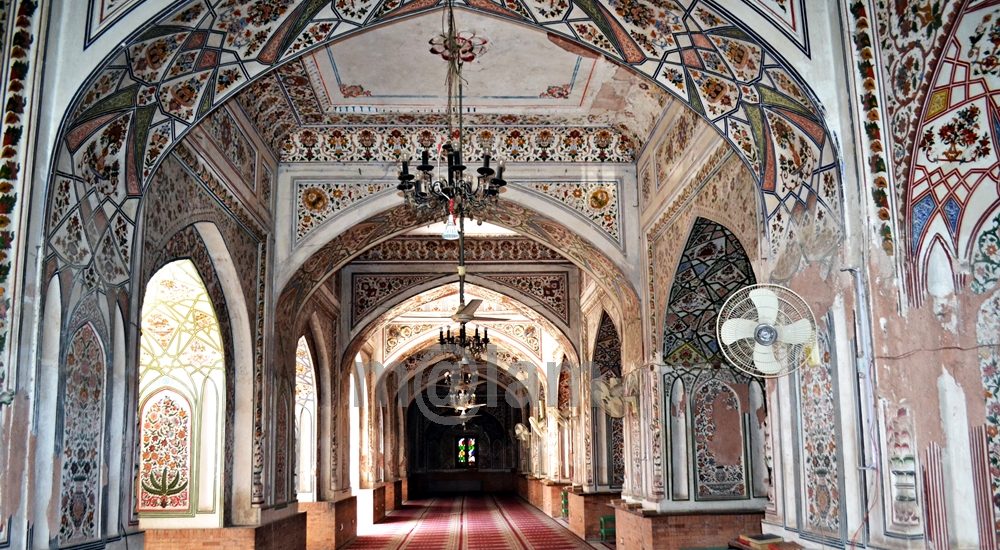
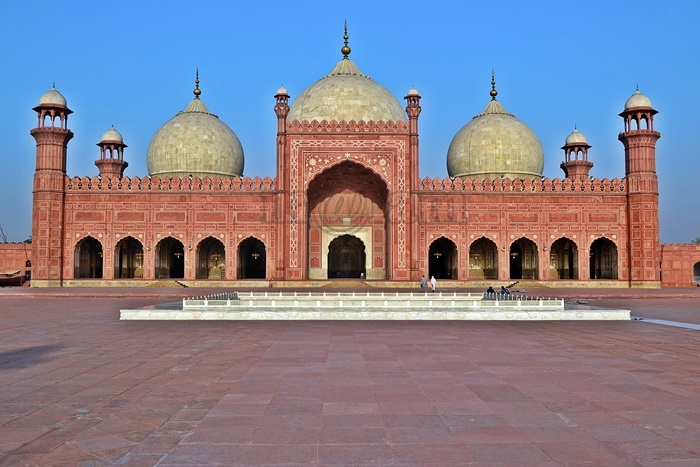
Exploring the Magnificence of the Badshahi Mosque in Lahore Unveiling the Grandeur of Lahore’s Crown Jewel The Badshahi Mosque, Lahore’s crown jewel, held the title of the world’s largest mosque for an impressive 313 years, spanning from 1673 to 1986. This glorious mosque was commissioned during the reign of the sixth Mughal emperor, Aurangzeb. This majestic structure stands as a testament to Mughal-era architecture. Even though it was constructed during the late Mughal period—a time marked by relative decline. This mosque encapsulates the beauty, passion, and grandeur of the Mughal era in Lahore. Beyond its religious significance, the mosque has witnessed several transformations. It served as a garrison for the armies of Ranjit Singh and the British troops after the fall of the Mughal Empire. Today, it ranks as the second-largest mosque in Pakistan and South Asia, and the fifth-largest in the world, with the capacity to accommodate nearly 150,000 worshippers within its hallowed grounds. A Glimpse of Its Location Situated on the outskirts of the Walled City of Lahore, the Badshahi Mosque’s imposing presence faces the Alamgiri Gate of Lahore Fort, another architectural marvel built by Aurangzeb. Only the Hazuri Bagh separates these two magnificent edifices. To the south of the Hazuri Bagh lies the Roshni Gate, one of the thirteen gates that once guarded the Walled City. Interestingly, the Hazuri Bagh doubled as a parade ground where Aurangzeb would review his troops and courtiers. Unveiling the History The iconic Badshahi Mosque owes its existence to the last Mughal Emperor, Aurangzeb, also known as Alamgir, which translates to “conqueror of the world.” This marvel of architecture was constructed in a mere two years, from 1671 to 1673. Although its design bears some resemblance to Delhi’s Jama Mosque, the Badshahi Mosque dwarfs its counterpart in size and grandeur. On a clear day, its impressive silhouette can be admired from a distance of approximately 15 kilometers (about 10 miles). Unlike his artistic predecessors, Aurangzeb prioritized military conquests over art and architecture during his rule. The construction of the Badshahi Mosque was driven by military objectives. Particularly, his campaign against the Indian warrior king of the Maratha clan, Shivaji Bhonsle. The construction project nearly depleted the Mughal treasury and weakened the empire itself. To safeguard the mosque from the Ravi River’s seasonal floods, it was built on an elevated plinth six meters above ground level. The responsibility for overseeing this monumental project fell upon Aurangzeb’s foster brother, Muzaffar Hussain (Fidai Khan Koka), who was also appointed as its governor. Art and Architecture The Badshahi Mosque’s architectural layout is a square, with each side spanning 170 meters. Due to its proximity to the Ravi River, a gate leading to the riverside could not be erected, resulting in an asymmetrical design with no southern gate. The mosque’s construction incorporates a combination of red stone and white marble inlay, setting it apart from the typical architectural style of mosques in Lahore. The design draws inspiration from Indo-Greek, Central Asian, and Indian architectural influences. Above the vaulted entrance, inlaid marble proudly displays the full name of the Badshahi Mosque: “Masjid Abul Zafar Muhy-ud-Din Mohammad Alamgir Badshah Ghazi.” Accessible via a staircase with 22 steps leading from Hazuri Bagh, the main entrance opens into a vast courtyard measuring 528 feet by 528 feet, capable of accommodating up to 100,000 worshippers simultaneously. The courtyard is divided into two levels—the upper and lower, where funeral prayers are also conducted. At its center lies a 50-foot by 50-foot, 3-foot deep central tank. Chamber The chamber directly above the mosque’s entrance gate once housed relics attributed to the Holy Prophet Muhammad (PBUH), His daughter, and His son-in-law. This chamber features Muqarna, an architectural feature in Islamic architecture characterized by ornamented vaulting It was first introduced in the nearby Wazir Khan Mosque. Prayer Hall The main prayer hall measures 275 feet by 83 feet by 50 feet in height. It features a central arched niche and five smaller niches, each one-third the size of the main niche. The mosque is crowned with three marble domes, with the central dome boasting a diameter of 65 feet at the base (70 feet at its bulging point), a height of 49 feet, a pinnacle rising to 24 feet, and a 15-foot high neck. The two side domes measure 51 feet 6 inches in diameter (54 feet 2 inches at their bulging point), with a height of 32 feet, a pinnacle reaching 19 feet, and a 9-foot 6-inch high neck. Interior The interior of the mosque, including its ceiling, is adorned with intricate floral frescoes, stucco tracery, and inlaid marble. On the exterior, meticulous stone carvings and marble inlays embellish the sandstone surface. The mosque’s capacity enables it to host up to 10,000 worshippers at once, with side chambers reserved for religious instruction. The mosque boasts four primary three-story octagonal minarets crafted from red stone and crowned with marble canopies. Each minaret soars to a height of 196 feet from its respective corner. Its outer circumference of 67 feet and its inner circumference of 8 feet 6 inches. Accessible by a staircase comprising 204 steps, these minarets accentuate the mosque’s grandeur. Additionally, the main mosque building features four smaller minarets, one at each corner. Transformations Through Sikh and British Eras The mosque’s grandeur suffered during Ranjit Singh’s rule, as his army seized Lahore in 1799. The main courtyard was repurposed as a stable, while the Hujras (cells) housed his soldiers. Nearby Hazuri Bagh was converted into the official Royal Court. Around 20 years later, a moderate earthquake struck, causing the marble turrets atop each minaret to collapse. These open minarets were then repurposed as gun emplacements during the Sikh Civil War in 1841, led by Ranjit Singh’s son Sher Singh. The adjacent Lahore Fort was under siege by supporters of Sikh Maharani Chand Kaur. The fort endured heavy bombardment, resulting in significant damage to the Dewan Aam (Hall of the Public Audience). Sikhs restricted Muslim access to the mosque for worship, designating only a small