
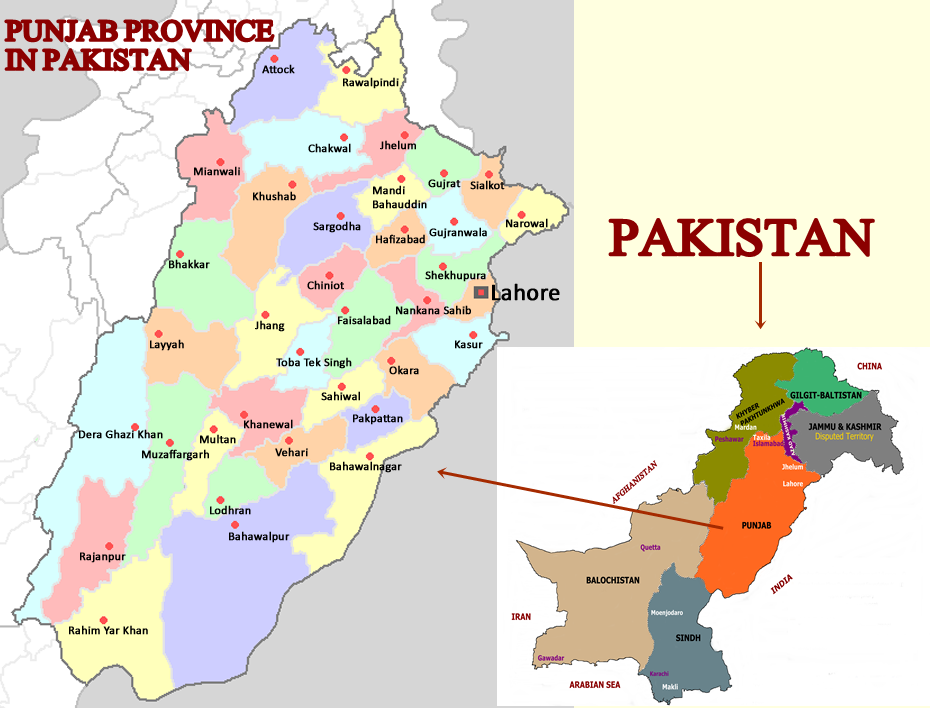
Punjab Province
Exploring Punjab: The Land of Five Rivers Punjab is a name derived from the Persian words Punj (meaning five) and Ab (meaning water). It quite literally translates to “(The land of) Five Rivers.” These five rivers are the Jhelum, Chenab, Ravi, Sutlej, and Beas. It’s important to note that the Beas River is now situated in Indian Punjab, while the Indus River is considered the fifth river of Punjab in Pakistan. The Punjab Province stands as the most fertile, populous, and prosperous province, housing approximately 56% of the nation’s population. Geographical Diversity Geographically, the Punjab province is a land of striking contrasts. It primarily consists of the alluvial plains of the Indus River and its four major tributaries: the Jhelum, Chenab, Ravi, and Sutlej rivers. Moreover, this diverse province spans an area of 205,344 square kilometers, ranging from the lush plains of the Indus River to the arid deserts of Cholistan, from the foothills of the Himalayas to the Potwar plateau and the Salt Range. Punjab is bordered by Kashmir to the northeast, the Indian state of Punjab and Rajasthan to the east, Sindh to the south, Baluchistan to the southwest, Khyber Pakhtunkhwa to the west, and Islamabad (the capital) to the north. Major Cities With 36 districts in the province, Lahore takes the crown as the provincial capital and the largest city. Lahore undoubtedly has a rich historical significance and was the capital of the broader Punjab region before the creation of Pakistan. Other significant cities in Punjab province include Bahawalpur, Multan, Gujranwala, Sargodha, Sialkot, Gujrat, Sheikhupura, Sahiwal, Faisalabad, Lahore, Jhelum, Attock, and Rawalpindi. A Journey Through History The history of Punjab is a tapestry woven with threads of diverse cultures and civilizations. Evidence suggests that humans settled along the banks of the Soan River more than 100,000 years ago. However, it was the ancient Harappan civilization, dating back 5,000 years, that laid the foundation for subsequent cultures in South Asia and Afghanistan. Over the centuries, Punjab saw waves of invaders from Greece, Central Asia, Iran, and Afghanistan, drawn to its strategic location. Throughout its storied past, Punjab has been a part of various empires and dynasties, including the Indus Valley Civilization, Aryans, Kushans, Scythians, Greeks, Persians, Arabs, Turks, Ghaznavids, Timurids, Afghans, Mughals, Sikhs, and the British, just before the formation of Pakistan. Traditionally, Punjab served as a focal point on the old Mughal Highway – the Grand Trunk Road (GT Rd) – connecting Central Asia to the Indian subcontinent. Lahore, long before partition, reigned as the capital for nearly a millennium, remaining a significant cultural, historical, and intellectual hub in the region. The partition of the subcontinent in 1947 marked a pivotal moment in Punjab’s history. The Muslim-dominated areas became the present-day province of Punjab, while the Sikh and Hindu-controlled regions formed the Indian states of Punjab. Today, Punjab stands as the heart of the nation, driving political and economic progress. Cultural Tapestry People Punjab is home to warm-hearted and fun-loving people, residing in both rural and urban areas. The province creates a heterogeneous society with diverse tribes, clans, and communities. In rural areas, traditional beliefs, superstitions, and cultural norms shape daily life, with practices like in-faqeers, Jogi, Taweez, manat-ka-dhaga, and belief in saints and black magic. In urban centers, however, literacy has ushered in rationality, blurring the lines of the caste system. Major Punjabi castes include Jats, Maliks, Mughals, Arains, Gujjars, Awans, Rajputs, Gakhars, Khokhars, Sheikhs, Kambohs, Niazis, Legharis, Khosas, Dogars, Mirani, Qureshis, and Syeds. Dresses Traditional attire for Punjabi men in villages comprises the Pagri (turban), dhoti/Lacha (loose cloth used as trousers), kurta (knee-length shirt), and Khusa (traditional shoes). Women, on the other hand, wear Gharara or churidar pajama or colorful shalwar kameez, Paranda, choli/dupatta, Khusa, kola puri chappal, or Tillay wali Jutti. In urban areas, however, fashion takes center stage, with both men and women donning trendy outfits. Religious Affiliation Punjab’s religious landscape has evolved over centuries. Initially, it was predominantly a Hindu state with Buddhist minorities before the arrival of Islam in 712 AD by Muhammad bin Qasim. The region later fell under Mughal rule for over two centuries, leaving behind architectural marvels, including mosques, forts, and gardens. Sufism, with its strong teachings, played a pivotal role in spreading Islam in Punjab. Today, the province is dotted with numerous Sufi shrines that attract millions of devotees annually. Arts and Crafts Punjab, as the most populous province, boasts a significant manufacturing industry, contributing substantially to Pakistan’s economy. Art and craft find their place in this rich tapestry, with major products including basketry, pottery, textiles, embroidered cloth woven on handlooms, cotton, silk, carpets, stonecraft, jewelry, metalwork, truck art, and woodwork. Culture Punjab’s culture traces its roots back to the highly developed Harappan Civilization. Subsequent civilizations have left their mark, shaping the culture in the realms of philosophy, poetry, music, art, architecture, and cuisine. Sufism has played a pivotal role in spreading harmony among the people. Punjab hosts a multitude of festivities that reflect its rich cultural traditions. Known for relatively liberal social attitudes in Pakistan, Punjab is a cultural melting pot. Languages The Punjab province is home to Punjabis and various other ethnic groups. Punjabi is, in fact, the mother tongue of 44% of Pakistanis. At the same time is understood by most of the population. Other languages, including Saraiki, Hindko, Pahari, and Pathowari, coexist alongside Punjabi. Additionally, Urdu serves as the national language, mainly in urban areas, while English is the official language for official communication. Festivals The people of the Punjab province enthusiastically celebrate both religious and cultural festivals. Revered religious festivals include Shab-e-Barat, Eid ul Fitr, Eid ul Adha, Eid Milad u Nabi, and Muharram. Cultural festivals like Baisakhi/Vaisakhi (Sikh festival), Basant, Teej, and Kanak Kati add to the vibrant tapestry of Punjab’s celebrations. Cuisine Punjabi cuisine is especially renowned for its delectable flavors. Traditional dishes often feature the use of oil or clarified butter, combined with an array of spices. Meals are typically enjoyed with rice or roti (bread). Breakfast favorites