
Mughal period architecture

Walled city of Lahore
City Breaks, Punjab

Walled City of Lahore

The one square kilometer densely populated walled city in the heart of Lahore houses a variety of architectural treasures and was once accessible by 13 gates. The Walled City of Lahore is also known as the Old City of Lahore and was established around 1000 CE. Most of the monuments housed in the city belong to the Mughal era, notably the lavishly decorated Wazir Khan Mosque, the massive Badshahi Mosque, and the Shahi Hammam. Gates of Walled City of Lahore The Walled City of Lahore was covered by a 9-meter high brick wall and accessible by 13 gates, made of wood and iron, with their unique names. These gates were constructed during the reign of Emperor Akbar (1584-98). The Raushnai Gate, or the Gate of Lights, is located between the royal mosque and the citadels. The Kashmiri Gate is called so because of its direction towards Kashmir. The Masti Gate, actually the Masjidi Gate refers to a mosque The Khizri or the Shranwala Gate was named after Khizr Elias, the patron saint. The Yakki Gate, originally the Zaki Gate, was a name derived from the name of a martyred saint while defending the city The Delhi Gate is called so because of its opening to the highway to Delhi. The Akbari Gate was named after the Mughal Emperor Muhammad Jala-ud-din Akbar who rebuilt the town and fort. The Mochi Gate was actually called Moti Gate to refer to Pearl named after Moti Ram, an officer of Akbar who resided here at that time. The Shah Almi Gate was named after the son and successor of Aurangzeb, Mohomed Mo’azzam Shah Alam Bahadur Shah who died on the 28th of February 1712 in Lahore. The Lahori Gate, also known as Lohari Gate, has been named after the city of Lahore. The Mori Gate was the smallest of all and was used as an outlet for the refused and sweepings of the city. The Bhatti Gate was named after the Bhatis, an ancient Rajput tribe that lived in these quarters. The Taxali Gate, named after the Taxal or Royal Mint During the reign of Ranjit Singh (1799 to 1849), the damaged walls were rebuilt in 1812. All of these marvelous gates continued to exist until the 19th century. Some damaged gates were rebuilt using simple structures, except for Delhi Gate and Lahori Gate. Currently, only 6 of these gates exist including Roshnae, Delhi, Shairanwala, Bhati, Kashmiri, and Lahori. Below is the detail of the hidden architectural treasure inside the Walled City Of Lahore Badshahi Mosque Badshahi Mosque Lahore The crown jewel of Lahore, the Badshahi Mosque, was a symbol of power in the Mughal Empire. It has been the largest mosque in the world for 313 years (1673 to 1986). The grand mosque was used more as a military base by the armies of Ranjit Singh and the British troops than as a religious structure. It is now the second largest in Pakistan and South Asia and 5th largest in the world with a capacity for more than 150,000 worshippers on its grounds.  Lahore Fort Lahore FortThe Lahore Fort or Shahi Qila is a citadel spreading over an area greater than 20 hectares located at the northern end of Lahore’s Walled City. It has 21 notable monuments, some of which date as far back as the era of Emperor Akbar. The Fort was almost entirely rebuilt in the 17th century when the Mughal Empire enjoyed the height of its reign. According to records, it was said to be a mud-brick fort in the 11th century but the foundation of the modern Lahore Fort was laid in 1566 during the reign of Emperor Akbar. The fort featured both Islamic and Hindu motifs in its architectural design. However subsequent amendments were carried out with the passage of time by the subsequent Mughal Emperors.  However, the facility was turned into the residence of Ranjit Singh, founder of the Sikh Empire, after the fall of the Mughal Empire and later passed on to the British who made some major changes in its design as per their own need. The fort was inscribed as a UNESCO World Heritage Site in 1981 for its “outstanding repertoire” of Mughal monuments dating from the era when the empire was at its artistic and aesthetic zenith.  Fort Road Food Street The Fort Road Food Street is a prominent yet mystifying street clustered with a great variety of food outlets where food enthusiasts of all colors and creeds gather for a taste of their choice, mostly made inside multi-story heritage buildings and served either along the street or on rooftops. These rooftops are surrounded by significant landmarks that provide magnificent views of the buildings clustered surrounding the old city. Food Street is also the best place to enjoy the dramatic sunset.  It is also a prominent tourist attraction located between Fort Road and Roshni Gate of the Walled City of Lahore. Historically the street was once taboo being a part of the renowned red light area of Lahore.  Wazir Khan Mosque Wazir Khan MosqueThe Mughal architecture in the subcontinent has been archetypal and has had no matching landmarks to date.  The Wazir Khan Mosque in Lahore is such a unique and vivid illustration of Mughal architecture. It is also a testimony of their affinity to finesse, frescos and dexterity. It has been described as “a mole on the cheek of Lahore”. Golden Mosque The Golden Mosque, locally known as the “Sunehri Masjid” or the Talai Mosque is a late Mughal architecture-era mosque in the Kashmiri Bazar of the famous Walled City (Old City) of Lahore. The mosque was built in 1753 by Nawab Syed Bhikari Khan, son of Raushan-ud-Daula Turrabaz Khan, deputy governor of Lahore during the reign of Muhammad Shah. It was the time when the Mughal Empire was in decline. The mosque was built on an 11-foot high plinth in a congested street accessible by 16 stairs opening to a small courtyard measuring 65 x 43 feet that further leads to the

Walled City of Lahore Read Post »
, , , , , , , , , , ,
Badshahi Mosque Lahore
Mosques, Punjab

Badshahi Mosque

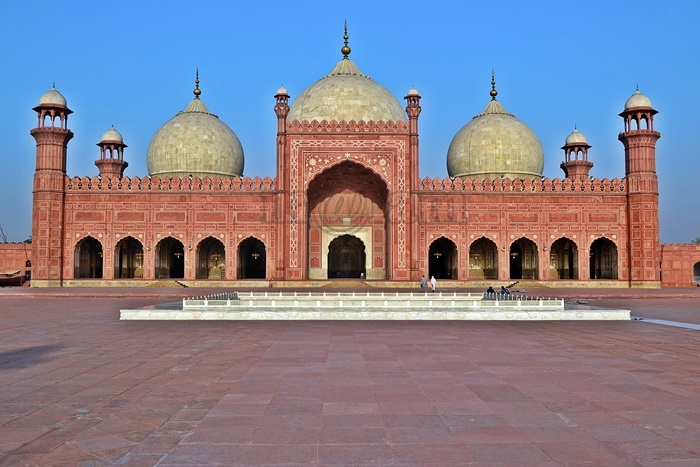
Exploring the Magnificence of the Badshahi Mosque in Lahore Unveiling the Grandeur of Lahore’s Crown Jewel The Badshahi Mosque, Lahore’s crown jewel, held the title of the world’s largest mosque for an impressive 313 years, spanning from 1673 to 1986. This glorious mosque was commissioned during the reign of the sixth Mughal emperor, Aurangzeb. This majestic structure stands as a testament to Mughal-era architecture. Even though it was constructed during the late Mughal period—a time marked by relative decline. This mosque encapsulates the beauty, passion, and grandeur of the Mughal era in Lahore. Beyond its religious significance, the mosque has witnessed several transformations. It served as a garrison for the armies of Ranjit Singh and the British troops after the fall of the Mughal Empire. Today, it ranks as the second-largest mosque in Pakistan and South Asia, and the fifth-largest in the world, with the capacity to accommodate nearly 150,000 worshippers within its hallowed grounds. A Glimpse of Its Location Situated on the outskirts of the Walled City of Lahore, the Badshahi Mosque’s imposing presence faces the Alamgiri Gate of Lahore Fort, another architectural marvel built by Aurangzeb. Only the Hazuri Bagh separates these two magnificent edifices. To the south of the Hazuri Bagh lies the Roshni Gate, one of the thirteen gates that once guarded the Walled City. Interestingly, the Hazuri Bagh doubled as a parade ground where Aurangzeb would review his troops and courtiers. Unveiling the History The iconic Badshahi Mosque owes its existence to the last Mughal Emperor, Aurangzeb, also known as Alamgir, which translates to “conqueror of the world.” This marvel of architecture was constructed in a mere two years, from 1671 to 1673. Although its design bears some resemblance to Delhi’s Jama Mosque, the Badshahi Mosque dwarfs its counterpart in size and grandeur. On a clear day, its impressive silhouette can be admired from a distance of approximately 15 kilometers (about 10 miles). Unlike his artistic predecessors, Aurangzeb prioritized military conquests over art and architecture during his rule. The construction of the Badshahi Mosque was driven by military objectives. Particularly, his campaign against the Indian warrior king of the Maratha clan, Shivaji Bhonsle. The construction project nearly depleted the Mughal treasury and weakened the empire itself. To safeguard the mosque from the Ravi River’s seasonal floods, it was built on an elevated plinth six meters above ground level. The responsibility for overseeing this monumental project fell upon Aurangzeb’s foster brother, Muzaffar Hussain (Fidai Khan Koka), who was also appointed as its governor. Art and Architecture The Badshahi Mosque’s architectural layout is a square, with each side spanning 170 meters. Due to its proximity to the Ravi River, a gate leading to the riverside could not be erected, resulting in an asymmetrical design with no southern gate. The mosque’s construction incorporates a combination of red stone and white marble inlay, setting it apart from the typical architectural style of mosques in Lahore. The design draws inspiration from Indo-Greek, Central Asian, and Indian architectural influences. Above the vaulted entrance, inlaid marble proudly displays the full name of the Badshahi Mosque: “Masjid Abul Zafar Muhy-ud-Din Mohammad Alamgir Badshah Ghazi.” Accessible via a staircase with 22 steps leading from Hazuri Bagh, the main entrance opens into a vast courtyard measuring 528 feet by 528 feet, capable of accommodating up to 100,000 worshippers simultaneously. The courtyard is divided into two levels—the upper and lower, where funeral prayers are also conducted. At its center lies a 50-foot by 50-foot, 3-foot deep central tank. Chamber The chamber directly above the mosque’s entrance gate once housed relics attributed to the Holy Prophet Muhammad (PBUH), His daughter, and His son-in-law. This chamber features Muqarna, an architectural feature in Islamic architecture characterized by ornamented vaulting It was first introduced in the nearby Wazir Khan Mosque. Prayer Hall The main prayer hall measures 275 feet by 83 feet by 50 feet in height. It features a central arched niche and five smaller niches, each one-third the size of the main niche. The mosque is crowned with three marble domes, with the central dome boasting a diameter of 65 feet at the base (70 feet at its bulging point), a height of 49 feet, a pinnacle rising to 24 feet, and a 15-foot high neck. The two side domes measure 51 feet 6 inches in diameter (54 feet 2 inches at their bulging point), with a height of 32 feet, a pinnacle reaching 19 feet, and a 9-foot 6-inch high neck. Interior The interior of the mosque, including its ceiling, is adorned with intricate floral frescoes, stucco tracery, and inlaid marble. On the exterior, meticulous stone carvings and marble inlays embellish the sandstone surface. The mosque’s capacity enables it to host up to 10,000 worshippers at once, with side chambers reserved for religious instruction. The mosque boasts four primary three-story octagonal minarets crafted from red stone and crowned with marble canopies. Each minaret soars to a height of 196 feet from its respective corner. Its outer circumference of 67 feet and its inner circumference of 8 feet 6 inches. Accessible by a staircase comprising 204 steps, these minarets accentuate the mosque’s grandeur. Additionally, the main mosque building features four smaller minarets, one at each corner. Transformations Through Sikh and British Eras The mosque’s grandeur suffered during Ranjit Singh’s rule, as his army seized Lahore in 1799. The main courtyard was repurposed as a stable, while the Hujras (cells) housed his soldiers. Nearby Hazuri Bagh was converted into the official Royal Court. Around 20 years later, a moderate earthquake struck, causing the marble turrets atop each minaret to collapse. These open minarets were then repurposed as gun emplacements during the Sikh Civil War in 1841, led by Ranjit Singh’s son Sher Singh. The adjacent Lahore Fort was under siege by supporters of Sikh Maharani Chand Kaur. The fort endured heavy bombardment, resulting in significant damage to the Dewan Aam (Hall of the Public Audience). Sikhs restricted Muslim access to the mosque for worship, designating only a small

Badshahi Mosque Read Post »

, , , , , , , ,
Scroll to Top