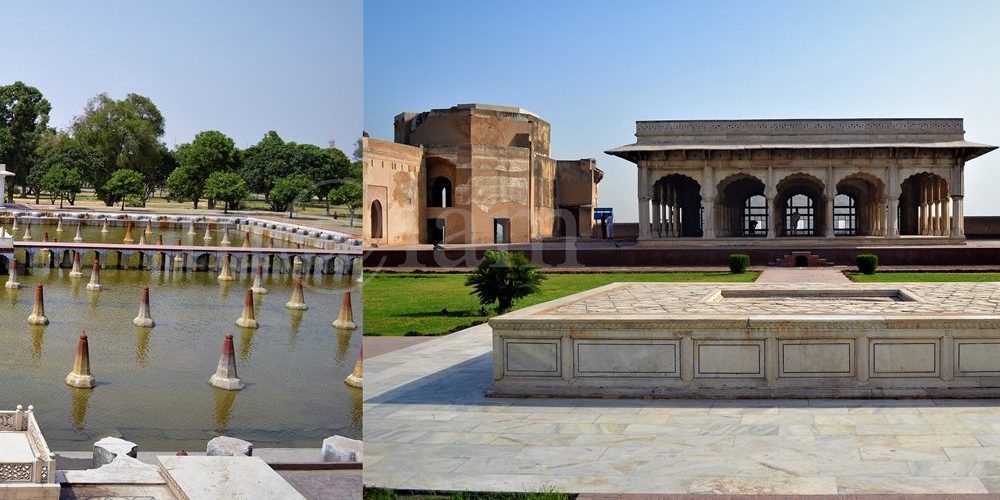
Lahore Fort

Lahore Fort
Forts, Heritage Sites in Pakistan, Punjab

Lahore Fort

Exploring the Majestic Lahore Fort: A Historical Masterpiece Lahore Fort, locally known as Shahi Qila, is a magnificent architectural marvel situated in the northwestern corner of Lahore’s historic city. This royal fort is not only a testament to its rich history but also stands as an architectural gem. The fort covers an expansive area of nearly 20 hectares, with dimensions measuring approximately 427 meters from east to west and 335 meters from north to south. It’s important to note that these measurements exclude the outer fortification wall added during Maharaja Ranjit Singh’s Sikh rule (1799 – 1839 A.D). A Storied Past The site of the modern Lahore Fort has witnessed centuries of history. Its origins date back to the 11th century when a mud-brick fort was first recorded during Mahmud of Ghazni’s rule. Over the centuries, the fort underwent numerous cycles of destruction, demolition, and reconstruction by various conquerors and rulers before falling under the domain of the Mughal emperors. In 1241, Mongols demolished the fort, and Sultan Balban of the Delhi Sultanate initiated its reconstruction in 1267. However, in 1398, Timur’s invading forces razed it to the ground once more, only for it to be resurrected by Mubarak Shah Sayyid in 1421. During the 1430s, the fort came under the occupation of Shaikh Ali of Kabul before ultimately falling under the control of the Pashtun Sultans of the Lodi dynasty. In 1524, the Mughal Emperor Babur captured Lahore, marking the start of its Mughal legacy. The occupation persisted until the decline of the Mughal dynasty. Subsequently, the Sikhs and later the British took control of the fort. Mughal Magnificence The foundations of the Lahore Fort as we know it today were laid in 1566 during the reign of Emperor Akbar (1556–1605), who made Lahore his capital. Akbar introduced architectural modifications to the fort, incorporating Hindu motifs into its design. Successive Mughal emperors, including Shah Jahan, left their mark on the fort. Shah Jahan, for instance, adorned it with luxurious marble featuring intricate Persian floral designs. In the 17th century, the fort underwent a comprehensive reconstruction, coinciding with the zenith of the Mughal Empire’s prestige and prosperity. Distinct Sections and Prominent Monuments The Lahore Fort is situated in close proximity to the Badshahi Mosque, separated only by the Hazuri Bagh. The fort comprises two primary sections: the northern half, which served as the private and residential area, and the southern half, designated for royal audiences and administrative functions. Within the fort, several notable monuments stand as testaments to its historical significance: 1-Akbari Gate (Masti Gate) Built by Emperor Akbar in 1566, this gate later became known as Masti Gate. Actually, the Empress of Akbar built a mosque outside this gate in 1614 A.D that still exists in good condition. The word” Masjid” (Mosque) in the local version was corruptly pronounced Maseet and transformed as Masti; thus the name Masti Gate was affixed. The fort during Akbar’s times had two gates including Masti Gate. The other gate was later replaced by Alamgiri Gate in 1673 A.D. 2-Alamgiri Gate The iconic Alamgiri Gate, located on its western side, opens in the Hazuri Bagh and faces the renowned Badshahi Mosque, was the masterpiece built by the last of the Mughal ruler Aurangzeb (ruled: 1658 – 1707 A.D) in 1673-74 a private entrance to the royal quarters enabling the elephants carrying members of the royal household enter at one time. It has two semi-circular bastions decorated with lotus petal designs at the base. 3-Diwan-i-Aam (Hall of Public Audience) Diwan-i-Aam is a forty-pillar complex built under the supervision of Asif Khan (brother of Nur Jahan – the empress of Shah Jahan’s father, Jahangir). It was built during the reign of Shah Jahan in 1631 to receive official visitors, make a daily public appearance to address the issues, and review parades. It was demolished when Ranjit Singh’s son Sher Singh bombarded Lahore Fort. The fort was destroyed with light guns during a fight against Chand Kaur, the widow of Kharak Singh (the elder son of Ranjit Singh). After the occupation of the fort in 1849 A.D. The British rebuilt Diwan-i-Aam. 4-Jahangir Quadrangles The northeast corner of the fort is made up of Jahangir’s Quadrangles. The construction of the Quadrangles started during the tenure of Akbar in 1617-18. However, it was completed by Jahangir in 1620 at a cost of seven lacs (Seven Hundred Thousand) rupees. The design of the Quadrangles reflects Akbar’s influence as it employs column brackets carved in the form of animals. Moreover, the quadrangle’s layout differs from the mainstream Mughal quadrangles and its features reflect Hindu temple architecture referring the Akbar’s policy of tolerance. Usually, the Mughal quadrangles used the layout of a Persian paradise garden, and instead, it is formed by concentric rectangles with a fountain in its center. 5-Diwan-i-Khas (Hall of Private Audience) Diwan-i-Khas is a hall commissioned by Shah Jahan where state guests were received and discussed matters related to the state. It is an arched pavilion built in semi-chaste marble and its parapet was decorated with pietra dura work (by inlaying semi-precious stones into white marble). 6-Khwabgah-e-Jahangir (Jahangir’s sleeping chamber) The north end of the quadrangle is dominated by the Barri Khwabgah, or ‘large bedroom’. It was Jahangir’s sleeping chamber attributed to Jahangir’s period and is located in the residential section. The current building is the reconstruction version from the British era. It is now used as a museum housing Mughal antiquities. 7-Khwabgah-e- Shah Jahan It was the sleeping chamber and the first building built by Shah Jahan under the supervision of Wazir Khan in 1634 during his first visit to the city. The Khwabgah comprises five sleeping chambers aligned in a single row. The carved marble screens inside the chambers are decorated with inlaid white marble and frescoes. The incised work known as Ghalib Kari in Urdu and the stucco tracery on the arches of this monument are the main features of this building.  Its original decorations have gone astray presently except for a trace of the

Lahore Fort Read Post »

, , , , , , , , , , , , , , , , , , , , , , , , , , , , , , , ,
Walled city of Lahore
City Breaks, Punjab

Walled City of Lahore

The one square kilometer densely populated walled city in the heart of Lahore houses a variety of architectural treasures and was once accessible by 13 gates. The Walled City of Lahore is also known as the Old City of Lahore and was established around 1000 CE. Most of the monuments housed in the city belong to the Mughal era, notably the lavishly decorated Wazir Khan Mosque, the massive Badshahi Mosque, and the Shahi Hammam. Gates of Walled City of Lahore The Walled City of Lahore was covered by a 9-meter high brick wall and accessible by 13 gates, made of wood and iron, with their unique names. These gates were constructed during the reign of Emperor Akbar (1584-98). The Raushnai Gate, or the Gate of Lights, is located between the royal mosque and the citadels. The Kashmiri Gate is called so because of its direction towards Kashmir. The Masti Gate, actually the Masjidi Gate refers to a mosque The Khizri or the Shranwala Gate was named after Khizr Elias, the patron saint. The Yakki Gate, originally the Zaki Gate, was a name derived from the name of a martyred saint while defending the city The Delhi Gate is called so because of its opening to the highway to Delhi. The Akbari Gate was named after the Mughal Emperor Muhammad Jala-ud-din Akbar who rebuilt the town and fort. The Mochi Gate was actually called Moti Gate to refer to Pearl named after Moti Ram, an officer of Akbar who resided here at that time. The Shah Almi Gate was named after the son and successor of Aurangzeb, Mohomed Mo’azzam Shah Alam Bahadur Shah who died on the 28th of February 1712 in Lahore. The Lahori Gate, also known as Lohari Gate, has been named after the city of Lahore. The Mori Gate was the smallest of all and was used as an outlet for the refused and sweepings of the city. The Bhatti Gate was named after the Bhatis, an ancient Rajput tribe that lived in these quarters. The Taxali Gate, named after the Taxal or Royal Mint During the reign of Ranjit Singh (1799 to 1849), the damaged walls were rebuilt in 1812. All of these marvelous gates continued to exist until the 19th century. Some damaged gates were rebuilt using simple structures, except for Delhi Gate and Lahori Gate. Currently, only 6 of these gates exist including Roshnae, Delhi, Shairanwala, Bhati, Kashmiri, and Lahori. Below is the detail of the hidden architectural treasure inside the Walled City Of Lahore Badshahi Mosque Badshahi Mosque Lahore The crown jewel of Lahore, the Badshahi Mosque, was a symbol of power in the Mughal Empire. It has been the largest mosque in the world for 313 years (1673 to 1986). The grand mosque was used more as a military base by the armies of Ranjit Singh and the British troops than as a religious structure. It is now the second largest in Pakistan and South Asia and 5th largest in the world with a capacity for more than 150,000 worshippers on its grounds.  Lahore Fort Lahore FortThe Lahore Fort or Shahi Qila is a citadel spreading over an area greater than 20 hectares located at the northern end of Lahore’s Walled City. It has 21 notable monuments, some of which date as far back as the era of Emperor Akbar. The Fort was almost entirely rebuilt in the 17th century when the Mughal Empire enjoyed the height of its reign. According to records, it was said to be a mud-brick fort in the 11th century but the foundation of the modern Lahore Fort was laid in 1566 during the reign of Emperor Akbar. The fort featured both Islamic and Hindu motifs in its architectural design. However subsequent amendments were carried out with the passage of time by the subsequent Mughal Emperors.  However, the facility was turned into the residence of Ranjit Singh, founder of the Sikh Empire, after the fall of the Mughal Empire and later passed on to the British who made some major changes in its design as per their own need. The fort was inscribed as a UNESCO World Heritage Site in 1981 for its “outstanding repertoire” of Mughal monuments dating from the era when the empire was at its artistic and aesthetic zenith.  Fort Road Food Street The Fort Road Food Street is a prominent yet mystifying street clustered with a great variety of food outlets where food enthusiasts of all colors and creeds gather for a taste of their choice, mostly made inside multi-story heritage buildings and served either along the street or on rooftops. These rooftops are surrounded by significant landmarks that provide magnificent views of the buildings clustered surrounding the old city. Food Street is also the best place to enjoy the dramatic sunset.  It is also a prominent tourist attraction located between Fort Road and Roshni Gate of the Walled City of Lahore. Historically the street was once taboo being a part of the renowned red light area of Lahore.  Wazir Khan Mosque Wazir Khan MosqueThe Mughal architecture in the subcontinent has been archetypal and has had no matching landmarks to date.  The Wazir Khan Mosque in Lahore is such a unique and vivid illustration of Mughal architecture. It is also a testimony of their affinity to finesse, frescos and dexterity. It has been described as “a mole on the cheek of Lahore”. Golden Mosque The Golden Mosque, locally known as the “Sunehri Masjid” or the Talai Mosque is a late Mughal architecture-era mosque in the Kashmiri Bazar of the famous Walled City (Old City) of Lahore. The mosque was built in 1753 by Nawab Syed Bhikari Khan, son of Raushan-ud-Daula Turrabaz Khan, deputy governor of Lahore during the reign of Muhammad Shah. It was the time when the Mughal Empire was in decline. The mosque was built on an 11-foot high plinth in a congested street accessible by 16 stairs opening to a small courtyard measuring 65 x 43 feet that further leads to the

Walled City of Lahore Read Post »

, , , , , , , , , , ,
Lahore Fort and Shalimar Garden
Heritage Sites in Pakistan, Islamic Heritage, Punjab, World Heritage Sites

Lahore Fort and Shalimar Garden

Exploring Lahore’s Magnificent Lahore Fort and Shalimar Garden: A Glimpse into Mughal Grandeur Lahore, the cultural heart of Pakistan, boasts two magnificent Mughal-era treasures: the Lahore Fort and Shalimar Garden. These architectural marvels continue to stand as symbols of pride and prestige in Lahore, having earned their rightful place as UNESCO World Heritage Sites of Pakistan in 1981, owing to their remarkable collection of Mughal monuments that epitomize the artistic and aesthetic zenith of the empire. The fort is located at the northwest corner of the walled city of Lahore while the Shalimar Gardens are situated along the Grand Trunk Road some 5 kilometers northeast of the main Lahore city. The monuments are located at a distance of 7 kilometers from each other. Dating back to 1the 7th century, both masterpieces reflect the true artistic expression of the Mughals at its peak.  The fort is the only monument that represents the complete history of Mughal architecture in Pakistan. The Shalimar garden, built by Emperor Shah Jahan in 1642, still retains the glorious Persian and Islamic tradition is a fine example of Mughal gardens. Lahore Fort: A Historical Marvel The Lahore Fort, also known as Shahi Qila, sprawls across an impressive 20 hectares. This irregularly designed citadel features 21 notable monuments, some dating back to the reign of Emperor Akbar. In the 17th century, during the peak of the Mughal Empire, the fort underwent extensive reconstruction. Its origins can be traced back to 1566 when Emperor Akbar laid the foundations for the modern Lahore Fort. Interestingly, the fort’s architectural design seamlessly blends Islamic and Hindu motifs, a testament to its rich history. As time passed, subsequent Mughal Emperors made alterations to the fort. Following the decline of the Mughal Empire, it served as the residence of Ranjit Singh, the founder of the Sikh Empire. Later, the British made significant modifications to suit their needs. Shalimar Garden: A Natural Paradise The Shalimar Gardens in Lahore represent an exceptional Mughal garden complex, seamlessly merging natural beauty with architectural grandeur. Commissioned by Emperor Shah Jahan in 1641, these gardens were completed in 1642, showcasing the pinnacle of Mughal artistry. Encompassing 16 hectares, the garden’s rectangular layout is enclosed by crenelated walls constructed from red sandstone. It is divided into three terraces, each with its own distinctive name. The upper terrace is named “Farah Baksh” (Bestower of Pleasure), the middle terrace “Faiz Baksh” (Bestower of Goodness), and the lower terrace “Hayat Baksh” (Bestower of Life). One of the most remarkable features of the Shalimar Gardens is its intricate water circulation system, comprising 410 fountains. These fountains, distributed throughout the three terraces, create a mesmerizing spectacle. The garden’s thermal engineering was designed to provide cooling relief to visitors during scorching summers, a feat that continues to baffle scientists today. While initially intended to entertain royal guests, a specific section of the Shalimar Gardens was open to the general public. Located just 5 kilometers northeast of Lahore’s city center, the garden’s land originally belonged to the Arian Mian Family. In recognition of their contributions to the Mughal Empire, Emperor Shah Jahan bestowed upon them the prestigious Mian title. The Lahore Fort and Shalimar Garden stand as enduring testaments to the Mughal Empire’s architectural and artistic brilliance. Their historical significance and timeless beauty continue to captivate visitors, making them indispensable landmarks in Lahore’s rich cultural heritage.

Lahore Fort and Shalimar Garden Read Post »

, , , , , , , , , , , ,
Scroll to Top