Tomb of Bibi Jawindi

Tentative list of UNESCO World Heritage Sites of Pakistan
Heritage Sites in Pakistan, Tourism Blogs, World Heritage Sites

Tentative List of UNESCO World Heritage Sites of Pakistan

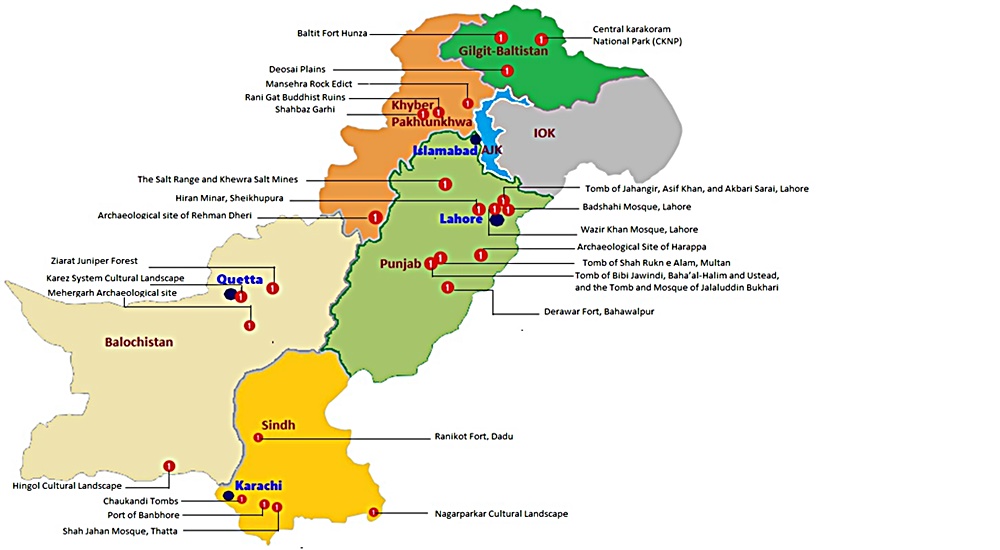
Tentative List of UNESCO World Heritage Sites of Pakistan Pakistan boasts six UNESCO World Heritage Sites. In addition to these established sites, the country has compiled a roster of 25 potential sites called the Tentative List of UNESCO World Heritage Sites of Pakistan seeking recognition. This catalog has been formally presented to the UNESCO Committee for assessment and approval. The pre-listing process is a mandatory step for the eventual acceptance of nominations onto the esteemed World Heritage list. Punjab Province The Salt Range and Khewra Salt Mine The Salt Range, rising abruptly from the Punjab plains in Pakistan, spans 180 km and features sheer escarpments, jagged peaks, and fertile valleys. Originating 800 million years ago, it formed from the evaporation of a shallow sea and underthrusting of the Indian Plate. Named for the thickest rock salt seams globally, the range is a geological treasure with fossiliferous stratified rocks and exposed strata, attracting global geologists. The region is rich in paleontological finds, including dinosaur trackways, Cretaceous belemnites, and ancient hominid remains. The Salt Range is a historical and cultural hub with sites dating from Alexander the Great‘s era to the British colonial period. Notably, Khewra hosts one of the world’s richest salt deposits, exploited for over a millennium, continuing as a mining, research, and tourism center. Badshahi Mosque, Lahore The Badshahi Mosque and its expansive courtyard are elevated on a platform accessible from the east via a grand staircase and a traditional Mughal-style gateway. The entrance, a two-story structure, boasts intricate decorations with framed and carved paneling on all facades. Square minarets with pseudo-pavilions in red sandstone and white marble cupolas adorn the four corners. Its tall octagonal minarets are positioned at the courtyard’s corners. Additionally, smaller octagonal minarets are attached to the prayer chamber’s corners, beneath three grand marble domes. The red sandstone exterior is subtly adorned with white marble inlay lines and patterns. The interior and exterior of the prayer chamber feature unique and beautifully crafted Zanjira interlacing and floral motifs in bold relief, showcasing unparalleled beauty and craftsmanship in Mughal architecture. The gateway’s inscription indicates its construction in A.H. 1084 (1673-74 A.D.). Wazir Khan Mosque, Lahore The Wazir Khan Mosque, covering an area of 279′ x 159′, is entirely constructed using cut and dressed bricks laid in kankar lime, with minimal use of red sandstone in the gate and transept. The courtyard is split into two sections, with the upper part slightly elevated and an ablution tank in the middle. Flanking the east, north, and south sides of the courtyard are 32 small hujras of varying sizes. The prayer chamber on the west side features five compartments divided by massive piers supporting wide, four-centered arches, each topped with a dome. Small rooms are created at the northern and southern ends, and an eastern gallery leads to a spiral staircase accessing the roof. Distinctive structural elements include four corner minarets, five domes, and a transept at the entrance gate on the east. According to inscriptions, the mosque was built in A.H. Archaeological Site of Harappa The archaeological site of Harappa, extending over 150 hectares, comprises eight mounds and two cemeteries situated to the south of the dry Ravi riverbed. While much of the site is buried beneath agricultural land or the modern village of Harappa, exposed structures on mounds AB and F date back to the third millennium BC. The site’s sequence spans from the fourth to the second millennium BC, with a depth of over 13 meters. The strategic location beside the old course of the Ravi River granted inhabitants access to trade networks, aquatic resources, and water for cultivation, explaining its prolonged occupation. Harappa’s town plan during the mature Harappan period (2600-1900 BC) features self-contained walled centers on raised mounds. The site’s unique urbanization declined in the second millennium BC, and subsequent developments, including brick removal for railway ballast in the 1850s and salination from irrigation agriculture, impacted the preservation of structures. Tombs of Jahangir, Asif Khan and Akbari Sarai, Lahore The Tombs of Jahangir, Asif Khan, and Akbari Sarai, designated on December 14, 1993, showcase remarkable Mughal architecture. Jahangir’s Tomb is a single-story structure with a square plan, featuring tall octagonal corner towers and a projecting entrance bay on each side. The exterior boasts red sandstone facing with intricate marble inlay decoration. The interior displays floral frescoes, delicate inlay work (pietra dura), and vibrant marble intersia. Asif Khan’s Tomb, an octagonal structure with a high bulbous dome, stands in a vast garden. Originally adorned with rich stone inlay and bold stucco tracery inside, it featured a high bulbous double dome covered with marble veneering. Akbari Sarai, between Jahangir and Asif Khan’s, includes an open courtyard with small cells, adorned gateways, and a mosque with three splendid domes. The Sarai and the entrance gateway seem part of a unified complex from Shah Jahan’s era, sharing similar styles and elements. Hiran Minar and Tank, Sheikhupura The Hiran Minar, erected under Emperor Jahangir’s reign in 1620 AD, boasts unique architectural elements. Its facade sports 210 square perforations arranged in 14 rows, while inside, a spiral staircase with 108 steps leads to the top, adorned with 11 rectangular arched openings. Divided into six tiers, the Minar showcases lime plaster possibly embellished with floral or linear frescoes. An arched entrance graces the lowest tier. Across from it lies a rectangular tank connected by a causeway to an octagonal baradari. Each corner features square pavilions with gateways. The tank, equipped with ramps, parapet walls, and staircases, connects to the Aik rivulet via a channel. Inside the baradari, intricately decorated niches and honeycomb patterns adorn the walls. The causeway, supported by 21 pointed arched pillars, links the main baradari to an octagonal platform in the tank’s center, which served as a royal residence. Tomb of Hazrat Rukn-e-Alam, Multan The tomb of Shah Rukn-i-Alam, constructed between 1320 and 1324 AD by the Tughluq ruler Ghiyas-ud-din, was initially meant for his dynasty but later dedicated to the family of the revered Sufi saint. This

Tourist attractions in Bahawalpur
City Breaks, Punjab

Bahawalpur Tourist Attractions

Bahawalpur, the capital city of the Bahawalpur district situated in the southern part of the Punjab province in Pakistan, holds historical significance as it was once a princely state under the rule of the Abbassi Nawabs from 1748 to 1954. During their 200-year reign, the Nawabs contributed to the city’s grandeur by constructing some remarkable landmarks, leaving behind an architectural legacy that still defines the city. As the 11th largest city in Pakistan and the 6th largest in Punjab province, Bahawalpur boasts well-preserved landmarks that serve as a testament to its rich history. The city is particularly attractive for visitors between October and February. While Bahawalpur has its own airport, travelers can also opt to fly into Multan and then drive to Bahawalpur. The city is accessible by air from major cities like Islamabad, Lahore, and Karachi, and by road from Karachi and Lahore as well. Key highlights of Bahawalpur include: Princely History: Bahawalpur served as a princely state under the Abbassi Nawabs for over two centuries, shaping the city’s cultural and historical identity. Architectural Marvels: The Abbassi Nawabs left behind mesmerizing landmarks that stand as a testament to their rule. These architectural gems contribute to the city’s unique charm and are well-preserved to this day. Ideal Visiting Season: The best time to visit Bahawalpur is between October and February, offering favorable weather conditions for exploration and sightseeing. Access: Bahawalpur has its own airport, but travelers can also choose to fly to Multan and then drive to Bahawalpur. The city is well-connected by air and road, with flights from major cities and accessible road routes from Karachi and Lahore. Overall, Bahawalpur is a city that invites visitors to explore its historical treasures, experience its cultural richness, and appreciate the architectural legacy left by the Abbassi Nawabs. Darawar Fort A must-visit attraction, Darawar Fort stands as a colossal citadel situated on the outskirts of the Cholistan Desert in Bahawalpur. Offering an exciting excursion from the city center, the fort is located approximately 95 km away, with a travel time of about 2 hours. The square-shaped fort’s immense size dominates the semi-desert landscape, easily visible from miles away. The fortified structure boasts 5-foot thick and 30-meter round bastioned walls, extending 1500 m in circumference, making it a robust and magnificent stronghold. While its exterior is particularly impressive, the interior may not match the grandeur witnessed from the outside. Abbassi Mosque or the White Marble Mosque The Abbasi Mosque, also known as the White Marble Mosque, is an elegant structure located in front of the Derawar Fort in Bahawalpur. Constructed in 1849 for the personal holy man of Nawab Bahawal Khan, Pir Ghulam Farid, this mosque is a striking representation of architectural beauty. Resembling the Moti Masjid at the Red Fort in Delhi, India, the Abbasi Mosque is entirely crafted from white marble, creating a pearl-like presence in the Cholistan Desert. The mosque features a spacious hall and courtyard, capable of accommodating up to 1000 worshippers simultaneously. Its tall minarets are visible from afar in the Cholistan desert, and despite the passage of time, the local residents have diligently maintained the mosque’s pristine condition. Abbasi Royal Graveyard The Abbasi Royal Graveyard, located in close proximity to the Abbasi Masjid in Derawar, serves as the final resting place for the Abbasi family. This sacred burial ground is under the ownership and control of the surviving family members of the Nawabs. The graveyard encompasses a covered area featuring a large rectangular room that serves as the resting place for 12 Nawabs who once governed the state of Bahawalpur. Additionally, the room contains the graves of Nawabs holding honorary titles after the amalgamation of Bahawalpur with Pakistan. Beyond the main rectangular room, other tombs belong to the immediate family of the Nawabs. These tombs showcase exceptional architectural craftsmanship and intricate artwork, including calligraphy, engravings, patchwork, and patterns. Visitors must obtain prior coordination and permission to explore this historic graveyard. Cholistan desert The Cholistan Desert, also referred to as Rohi, is a vast desert situated in Bahawalpur, Pakistan, covering an expansive area of approximately 26,000 square kilometers. Renowned for its distinctive ecosystem, this desert is a habitat for a diverse array of plants and animals. Beyond its ecological richness, the Cholistan Desert is steeped in historical significance, featuring numerous forts and tombs that trace their roots back to the ancient Indus Valley Civilization. The desert has become a favored destination for adventure tourism, offering activities such as desert safaris and camel treks, allowing visitors to immerse themselves in the unique landscapes and cultural heritage of the Cholistan region. Lal Sohanra National Park Established in 1972, Lal Sohanra National Park is a prominent conservation area among Pakistan’s 14 major national parks and protected regions, located approximately 50 km east of Bahawalpur. Recognized as a UNESCO-declared biosphere reserve, it stands as one of the largest national parks in South Asia. The park spans 127,480 acres, with 20,974 acres dedicated to green land (irrigated plantations), 101,726 acres to dry land (desert), and 4,780 acres to wetland (ponds and lakes). This sanctuary is home to a variety of wildlife, including the rare Chinkara Gazelle and abundant wild boar, while winter brings a multitude of ducks to the lakes. The park is intersected by the dry bed of the Hakra River, featuring the significant wetland of Patisar Lake. Accommodation options include a modest facility provided by the Pakistan Tourism Development Corporation (PTDC), and camping is also available in selected campsites within the park. Sadiq Garh Palace The grandeur and magnificence of Sadiq Garh Palace surpass even the enchanting palaces in Bahawalpur. Set amidst lush green lawns adorned with beautiful plants and flowers, and enclosed by a massive fortification, this sky-high structure features a central dome surrounded by bastions at each corner, showcasing the exquisite architectural taste of the Nawab’s family. The palace radiates an even more graceful aura at night, illuminated by a kaleidoscope of colored lights. The interior is adorned with top-quality furniture and embellishments. Established in 1882 by Nawab

Scroll to Top