
Sindh

Tentative list of UNESCO World Heritage Sites of Pakistan
Blogs, Heritage Sites in Pakistan, World Heritage Sites

Tentative List of UNESCO World Heritage Sites of Pakistan

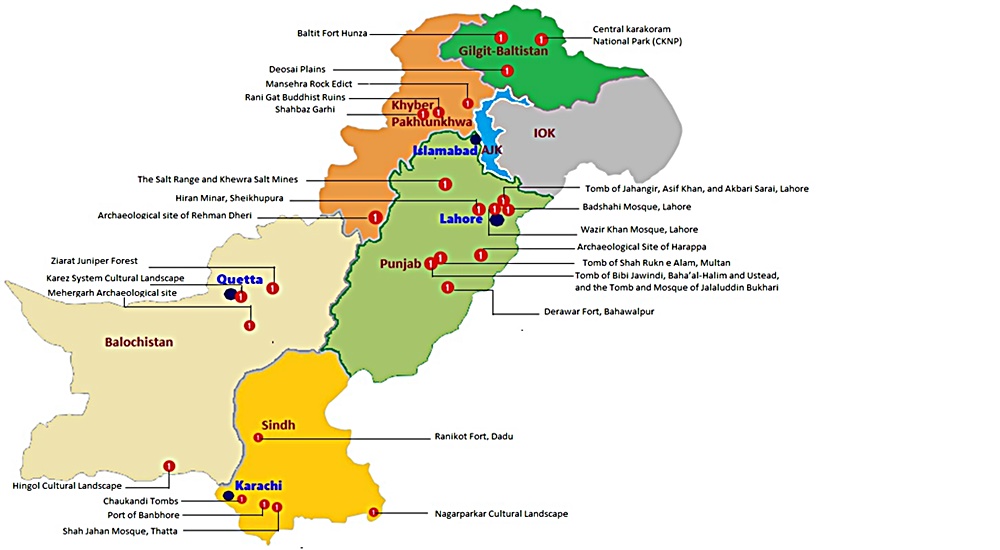
Tentative List of UNESCO World Heritage Sites of Pakistan Pakistan boasts six UNESCO World Heritage Sites. In addition to these established sites, the country has compiled a roster of 25 potential sites called the Tentative List of UNESCO World Heritage Sites of Pakistan seeking recognition. This catalog has been formally presented to the UNESCO Committee for assessment and approval. The pre-listing process is a mandatory step for the eventual acceptance of nominations onto the esteemed World Heritage list. Punjab Province The Salt Range and Khewra Salt Mine The Salt Range, rising abruptly from the Punjab plains in Pakistan, spans 180 km and features sheer escarpments, jagged peaks, and fertile valleys. Originating 800 million years ago, it formed from the evaporation of a shallow sea and underthrusting of the Indian Plate. Named for the thickest rock salt seams globally, the range is a geological treasure with fossiliferous stratified rocks and exposed strata, attracting global geologists. The region is rich in paleontological finds, including dinosaur trackways, Cretaceous belemnites, and ancient hominid remains. The Salt Range is a historical and cultural hub with sites dating from Alexander the Great‘s era to the British colonial period. Notably, Khewra hosts one of the world’s richest salt deposits, exploited for over a millennium, continuing as a mining, research, and tourism center. Badshahi Mosque, Lahore The Badshahi Mosque and its expansive courtyard are elevated on a platform accessible from the east via a grand staircase and a traditional Mughal-style gateway. The entrance, a two-story structure, boasts intricate decorations with framed and carved paneling on all facades. Square minarets with pseudo-pavilions in red sandstone and white marble cupolas adorn the four corners. Its tall octagonal minarets are positioned at the courtyard’s corners. Additionally, smaller octagonal minarets are attached to the prayer chamber’s corners, beneath three grand marble domes. The red sandstone exterior is subtly adorned with white marble inlay lines and patterns. The interior and exterior of the prayer chamber feature unique and beautifully crafted Zanjira interlacing and floral motifs in bold relief, showcasing unparalleled beauty and craftsmanship in Mughal architecture. The gateway’s inscription indicates its construction in A.H. 1084 (1673-74 A.D.). Wazir Khan Mosque, Lahore The Wazir Khan Mosque, covering an area of 279′ x 159′, is entirely constructed using cut and dressed bricks laid in kankar lime, with minimal use of red sandstone in the gate and transept. The courtyard is split into two sections, with the upper part slightly elevated and an ablution tank in the middle. Flanking the east, north, and south sides of the courtyard are 32 small hujras of varying sizes. The prayer chamber on the west side features five compartments divided by massive piers supporting wide, four-centered arches, each topped with a dome. Small rooms are created at the northern and southern ends, and an eastern gallery leads to a spiral staircase accessing the roof. Distinctive structural elements include four corner minarets, five domes, and a transept at the entrance gate on the east. According to inscriptions, the mosque was built in A.H. Archaeological Site of Harappa The archaeological site of Harappa, extending over 150 hectares, comprises eight mounds and two cemeteries situated to the south of the dry Ravi riverbed. While much of the site is buried beneath agricultural land or the modern village of Harappa, exposed structures on mounds AB and F date back to the third millennium BC. The site’s sequence spans from the fourth to the second millennium BC, with a depth of over 13 meters. The strategic location beside the old course of the Ravi River granted inhabitants access to trade networks, aquatic resources, and water for cultivation, explaining its prolonged occupation. Harappa’s town plan during the mature Harappan period (2600-1900 BC) features self-contained walled centers on raised mounds. The site’s unique urbanization declined in the second millennium BC, and subsequent developments, including brick removal for railway ballast in the 1850s and salination from irrigation agriculture, impacted the preservation of structures. Tombs of Jahangir, Asif Khan and Akbari Sarai, Lahore The Tombs of Jahangir, Asif Khan, and Akbari Sarai, designated on December 14, 1993, showcase remarkable Mughal architecture. Jahangir’s Tomb is a single-story structure with a square plan, featuring tall octagonal corner towers and a projecting entrance bay on each side. The exterior boasts red sandstone facing with intricate marble inlay decoration. The interior displays floral frescoes, delicate inlay work (pietra dura), and vibrant marble intersia. Asif Khan’s Tomb, an octagonal structure with a high bulbous dome, stands in a vast garden. Originally adorned with rich stone inlay and bold stucco tracery inside, it featured a high bulbous double dome covered with marble veneering. Akbari Sarai, between Jahangir and Asif Khan’s, includes an open courtyard with small cells, adorned gateways, and a mosque with three splendid domes. The Sarai and the entrance gateway seem part of a unified complex from Shah Jahan’s era, sharing similar styles and elements. Hiran Minar and Tank, Sheikhupura The Hiran Minar, erected under Emperor Jahangir’s reign in 1620 AD, boasts unique architectural elements. Its facade sports 210 square perforations arranged in 14 rows, while inside, a spiral staircase with 108 steps leads to the top, adorned with 11 rectangular arched openings. Divided into six tiers, the Minar showcases lime plaster possibly embellished with floral or linear frescoes. An arched entrance graces the lowest tier. Across from it lies a rectangular tank connected by a causeway to an octagonal baradari. Each corner features square pavilions with gateways. The tank, equipped with ramps, parapet walls, and staircases, connects to the Aik rivulet via a channel. Inside the baradari, intricately decorated niches and honeycomb patterns adorn the walls. The causeway, supported by 21 pointed arched pillars, links the main baradari to an octagonal platform in the tank’s center, which served as a royal residence. Tomb of Hazrat Rukn-e-Alam, Multan The tomb of Shah Rukn-i-Alam, constructed between 1320 and 1324 AD by the Tughluq ruler Ghiyas-ud-din, was initially meant for his dynasty but later dedicated to the family of the revered Sufi saint. This

Tentative List of UNESCO World Heritage Sites of Pakistan Read Post »

, , , , , , , , , , , , , , , , , , , , , , , , , , , , , , , , , , , , , , , , , , , , ,
Sindh Province
Blogs, Sindh

Sindh Province of Pakistan

Discover Sindh:  The Jewel of Southern Pakistan Sindh, the third-largest province of Pakistan, boasts Karachi as its bustling capital. Locally called “Mehran,” Sindh spans 54,407 square miles (140,914 square kilometers) and is home to over 47.8 million people (as per the 2017 census). Known for its rich cultural heritage and urbanized population (52.02%), Sindh offers a unique blend of history, tradition, and modernity. Geography of Sindh Situated in southeastern Pakistan, Sindh forms the lower Indus Basin. The landscape is predominantly flat, with the Kirthar Range marking its western boundary with Balochistan. To the northeast lies Punjab, while the east borders the Indian states of Rajasthan and Gujarat. The Arabian Sea graces its southern edge, adding scenic coastal beauty. Major Cities in Sindh Sindh comprises 29 districts, with Karachi hosting five of them. Key cities include: Karachi: The cosmopolitan hub and gateway to Sindh. Hyderabad: Renowned for its cultural richness and historical landmarks. Sukkur: Famous for its iconic bridges and river views. Thatta: Known for ancient sites and the Makli Necropolis. A Rich Historical Blend The name “Sindh” originates from the Sanskrit word “Sindhu,” meaning ocean or river, specifically referring to the Indus River. Over millennia, the region evolved through numerous civilizations and empires: Early Settlements: Dating back to 7000 BCE, with Mehrgarh expanding into Sindh and giving rise to the Indus Valley Civilization (3000–1500 BCE). Empires and Conquests: Conquered by the Persian Achaemenid Empire, Alexander the Great, and subsequently the Mauryan Empire. Islamic Era: In 711 AD, Muhammad bin Qasim introduced Islam to Sindh, earning it the title “Bab-ul-Islam” (Gateway to Islam). Dynastic Rule: Sindh saw seven ruling dynasties, including the Mughals and Talpurs, before becoming part of British India in the 19th century. Cultural Heritage of Sindh Sindh’s vibrant culture is reflected in its arts, crafts, and traditions: Clothing: Colorful attire is a hallmark. Women wear tie-dyed shawls and saris, while men don embroidered Sindhi caps and traditional lungis. Religious Influence: Sufi shrines play a central role, with devotional music and ceremonies forming a key part of rural life. Arts and Crafts: The region boasts 5,000 years of craftsmanship, including Ajrak (block-printed fabric), pottery, woodwork, and hand-woven textiles. Languages in Sindh Sindhi is the primary language, though regional dialects like Kutchi, Lari, and Saraiki are also prevalent. Karachi, a melting pot of cultures, is multilingual, with Urdu and English serving as key languages. Tourist Attractions in Sindh Sindh is a treasure trove of historical, architectural, and natural wonders, including: Mohenjo-Daro: A UNESCO World Heritage Site showcasing the Indus Valley Civilization. Ranikot Fort: Known as the Great Wall of Sindh. Shah Jahan Mosque: A masterpiece of Mughal architecture in Thatta. Makli Necropolis: One of the largest graveyards in the world. Keenjhar Lake: A serene escape for nature lovers. Karachi’s Landmarks: Quaid-e-Azam’s Mausoleum, Clifton Beach, and colonial-era buildings. Sindh’s Economy Sindh’s economy thrives on agriculture, with cotton, rice, wheat, and sugarcane as major crops. It is also famous for producing dates, mangoes, and bananas. Handicrafts, pottery, and textiles contribute to its economic landscape, continuing a legacy from the Indus Valley Civilization. Climate and Best Time to Visit Sindh experiences a tropical climate: Summers: Hot and dry (30–50°C). Winters: Mild and pleasant (10–30°C). The ideal time to visit is between November and March when the weather is more comfortable for exploring. Things to Do in Sindh Explore ancient ruins at Mohenjo-Daro. Visit Sufi shrines and experience local spirituality. Take a boat ride on Keenjhar or Haleji Lake. Discover architectural gems like Kot Diji Fort and Noor Mahal. Enjoy the vibrant city life of Karachi. Getting to Sindh Sindh is accessible via air, road, and rail: Air Travel: Jinnah International Airport (Karachi) connects to international and domestic destinations. Road and Rail: Well-connected highways and train services link Sindh to other major cities in Pakistan. Sindh’s diverse history, vibrant culture, and breathtaking landscapes make it a must-visit destination for history buffs, nature lovers, and cultural enthusiasts alike. Plan your trip to this enchanting province and experience the wonders of southern Pakistan! You may also want to read: Gilgit-Baltistan Islamabad Capital City Azad Jammu & Kashmir Khyber Pakhtunkhwa Punjab Balochistan

Sindh Province of Pakistan Read Post »

, , , , , , , ,
Key Facts about Pakistan
Blogs

Pakistan

Exploring Pakistan: A Treasure Trove of Diverse Experiences Pakistan stands as an exceptional and blessed nation, graced with some of Asia’s most breathtaking landscapes. Its geography is as varied as its rich cultures, and its people are known for their warm hospitality. In the realm of discovering the roots of modern-day humanity, few places on Earth rival Pakistan. Unraveling the Tapestry of History The land that now comprises Pakistan has been a cradle of ancient civilizations and a melting pot of cultures and dynasties for centuries. From the ancient Neolithic Mehergarh civilization, dating back 9000 years, to the illustrious 5000-year-old bronze age Indus Valley Civilization, the 3000-year-old Buddhist Gandhara Civilization, the opulent Mughal Era of the 16th century, the brief Sikh rule, to over two centuries of British occupation, leading to independence in 1947, Pakistan’s history is a tapestry of unparalleled events, unlike any other sovereign state. A Glimpse of Pakistan’s Geography Officially, the country is known as the Islamic Republic of Pakistan. Most importantly, Pakistan ranks as the 6th most populous nation in South Asia. Altogether, the country houses over 224 million people from diverse cultural and ethnic backgrounds. Encompassing 881,913 square kilometers (340,509 square miles), Pakistan boasts four provinces – Sindh, Baluchistan, Punjab, and Khyber Pakhtunkhwa – and three territories – Islamabad, Kashmir, and Gilgit-Baltistan. The carefully planned capital city, Islamabad, lies at the heart of this diverse nation. Pakistan’s strategic location at the crossroads of Asia divides it into three major geographic regions: the northern highlands, the Indus River plains, and the Balochistan Plateau. Bordered by the Arabian Sea’s 1046-kilometer coastline in the south, India to the east, China to the northeast, Afghanistan to the northwest, and Iran to the southeast, Pakistan’s diverse landscape includes glaciated mountain ranges in the north (Gilgit-Baltistan), fertile alluvial plains, expansive deserts, lush forests, plateaus, jungles, diverse flora and fauna, meandering rivers, and pristine lakes. A Bounty of Tourist Attractions Pakistan is a treasure trove of tourist attractions, each region offering a unique experience. Northern Adventures The northern mountainous regions encompass parts of KPK (Chitral, Swat, and the Kaghan Valley), Azad  Kashmir, and all of Gilgit-Baltistan. Altogether, the region forms the westernmost edge of the magnificent Himalayas. This area is a haven for adventure enthusiasts offering opportunities for trekking and mountaineering. Moreover, climbing, white-water rafting, mountain and desert jeep safaris, and paragliding are other activities adventurers can take up. Gilgit-Baltistan is proud to host the world’s highest mountains and longest glaciers outside the polar regions. The region undoubtedly makes it a magnet for adventurers. This region also marks the convergence of three mighty mountain ranges – the Karakoram, the Hindukush, and the Himalaya – along with the Pamir mountain range. It was once a vital trade route of the ancient Silk Route. Now, it is embodied by the Karakoram Highway, connecting Pakistan and China at Khunjerab Pass. This highway is adorned with over 100,000 petroglyphs and rock carvings, testifying to its rich Buddhist history. The region’s towering mountains, quaint valleys, terraced fields, ancient forts showcasing architectural marvels, and a history spanning centuries beckon travelers. Central Treasures Pakistan’s central regions feature dense forests, vast deserts, and fertile lands steeped in history and culture, boasting unique landmarks. In fact, ancient sites like Moenjo-Daro & Harappa of the Indus Valley Civilization, Taxila & Takht-i-Bahi of the Gandhara Civilization, and architectural gems from the Islamic era, Mughal Empire, Sikh rule, and the British era, found in cities like Lahore, Multan, Bahawalpur, Karachi, and Peshawar, enthrall domestic and international visitors alike. Southern Charms The southern regions, Sindh and Baluchistan, boast archaeological sites, religious landmarks, and architectural heritage. At the same time, its lakes and some of the world’s most stunning golden beaches along the coastal line earned a special place in the world of tourism. The Makran Coastal Highway from Karachi to Gwadar and Jiwani is a world-famous route, dotted with exclusive tourist attractions. Pakistan proudly hosts six UNESCO World Heritage Sites, with several dozen more awaiting recognition. The Rich Tapestry of Pakistani Culture Pakistan’s major cities bear the marks of both history and modernity. Diverse ethnic groups, each with its own cultural background, inhabit different parts of these cities. Moreover, these groups practice various faiths, wear vibrant costumes, speak unique languages, savor rich cuisine, and coexist harmoniously. This diversity, combined with the legendary hospitality of the people, evidently paints a true portrait of Pakistan. Accessing Pakistan Pakistan is accessible by road from China via the Khunjerab border and remains open from April to October end.  Similarly, Pakistan is accessible from Afghanistan via the Khyber Pass in the northwest. Likewise, Pakistan is accessible from Iran via the Taftan border, and from India via the Wahga border. Similarly, Pakistan is well-connected to the world through its international airports in Islamabad, Lahore, Multan, Peshawar, Sialkot, and Karachi. Embracing the Seasons Pakistan’s distinct seasons are complemented by its stunning landscapes. It includes towering mountain ranges, expansive glaciers, crystal-clear lakes, flowing rivers, extensive highways, trekking routes, terraced fields, historical monuments, diverse cuisines, and cultural tapestry, creating an enticing destination that attracts tourists in abundance.

Pakistan Read Post »

, , , , , , , , , , , , ,
Makli Necropolis
City Breaks, Heritage Sites in Pakistan, Monuments, Sindh, Tombs, World Heritage Sites

Makli Necropolis

Unveiling the Enigma: Makli Necropolis – A Treasure Trove of History and Artistry Nestled in a diamond-shaped expanse, the grandeur of the Makli Necropolis in Thatta is unparalleled. It boasts of its status as one of the largest graveyards globally covering a sprawling 10 square kilometers. Altogether, the Makli Necropolis houses an astonishing half-million monuments. The graveyard stands as the final resting place for an eclectic mix of individuals, from regal monarchs and erudite scholars to valiant warriors, philosophers, governors, and revered saints. In recognition of its historical significance, Makli Necropolis, therefore, earned its place among the UNESCO World Heritage Sites of Pakistan in 1981. A Journey Through Time: Unraveling the History of Makli Necropolis Delving into the annals of history, Makli Necropolis emerges as the eternal abode for over 125,000 saints. Throughout the ages, this city has undeniably been a beacon of knowledge housing around 400 educational institutions. Here students from the Muslim world and Asia came to hone their skills. Students generally engaged in a diverse array of subjects encompassing religion, politics, and philosophy.  Yet, the enigmatic origins of Makli remain shrouded in mystery. It is widely believed that the cemetery evolved around the shrine of the 14th-century Sufi Hamad Jamali. As for the etymology of “Makli,” two intriguing notions persist. Locals suggest that it signifies “Mecca-like,” while another legend ties it to the pious woman known as “Mai Makli.” Legend has it that her fervent prayers thwarted Sultan Firuz Shah Tughlaq’s conquest of Thatta until her passing. She now rests in Makli near the tomb of Jam Nizamuddin. Thatta enjoyed a glorious stint as the capital of Sindh from the 14th to the 18th centuries. Initially, it was ruled by three successive dynasties – Samma, Argun, and Tarkhan. However, it later came under the dominion of the Mughal emperors of Delhi from 1592 to 1739 before being ceded to Shah Nadir of Iran, marking the beginning of a period marked by decline and neglect. The Architectural Marvels of Makli Necropolis The monuments of Makli Necropolis are a testament to the social and political history of Sindh from the 14th to the 18th centuries. Crafted with exquisite architectural finesse, these tombs and graves epitomize the artistic prowess of their time. The tombs were built by utilizing an array of materials such as sand bricks, stone, and marble. Some of these monuments are opulently adorned with glazed tiles, boasting intricate designs, arched domes, and towers adorned with exquisite Islamic calligraphy and devotional carvings inspired by diverse religious and iconographic traditions. Remarkably, many of these iconic monuments have withstood the test of time, enduring centuries of exposure to the elements. However, preserving this rich heritage for future generations necessitates substantial restoration efforts. Makli Necropolis: A Journey Through Location and Access Situated adjacent to the tip of the Indus River delta, Makli Necropolis lies on the outskirts of Thatta.  It was an ancient bastion of Islamic civilization nestled at the edge of the 6.5-kilometer-long plateau of Makli. This historic site is located approximately 89 kilometers east of Karachi in the Sindh province of southern Pakistan. Makli offers an ideal day trip from the bustling metropolis of Karachi. Navigating the vast expanse of the graveyard is made convenient through its wide streets, ensuring access to all the awe-inspiring monuments. Makli Necropolis undoubtedly stands as a testament to the rich tapestry of history, culture, and artistry. The graveyard has woven itself into the very fabric of this remarkable site. It beckons not only to history enthusiasts but also to travelers, both domestic and international, and devout pilgrims alike, offering a glimpse into an enigmatic past that continues to captivate our imaginations.

Makli Necropolis Read Post »

, , , , , , , , , , , , , ,
Scroll to Top